
The Taste of Things, sumptuous and sensual from the opening shot, oozes onto the screen in a dialogue-free first thirty minutes in which pots, pans, spoons and ladles full of everything you’ve ever desired to eat are meticulously assembled into a gourmand’s delight. From this mouth-watering start it never lets up; serving a succulent slice of sensuality, in every single shot of its just over two and a quarter hours of run time. And your appetite for more, never relents; not even when they begin again at the end. Really, it should be watched while reclining on deep velvet cushions, alongside someone with whom you have shared all the very best things in life. Either that or from a bath of warm crème anglaise.
But not, as I did, with white-skinned, white-haired, middle-aged couples in front, behind and to either side, who, between them were incapable of remaining silent, or looking at their phones, for the entire duration of the film.
I met the woman to the front, in the queue for tickets. As I arrived, there was one person waiting to be served behind the velvet rope, queue-definer thing, which was positioned in a slightly ambiguous way, such that you had to look at it for more than a couple of seconds to figure out at which end you joined (clue: it was the one furthest from the till). I had been in it for about thirty seconds, when she joined, in front of me, from the wrong end. I said nothing. Eventually, the person ahead of us went to the till, and shortly after that, a second server arrived to serve the woman who had butted-in ahead of me. She didn’t need tickets, just popcorn, but she couldn’t decide whether to have salty or sweet. While she mulled it over at the confectionary counter, a gap formed between her, and the person being served. So, I asked her, very gently, and politely, slightly nervously actually, because it pays to be aware of how easily some people can feel invaded upon, whether she was also queueing for tickets. The gap behind the person being served, suggested to any newcomers deploying the same lack of diligence as her, that there was no queue to join. Silence. And then, after a moment of what used to be called dumb insolence, looked away from me, and said, with a sort of begrudging hostility, “You can if you must.” I thanked her, and was careful to pass her without brushing coats. Whereupon, a middle-aged couple arrived directly at the till, and, as you’ve probably guessed, failed to acknowledge my greater right to be served in front of them. I would say that the facial expressions they used to communicate with me were of the nature of implying, that were it not for contemptible types, like me, life would be almost tolerable.
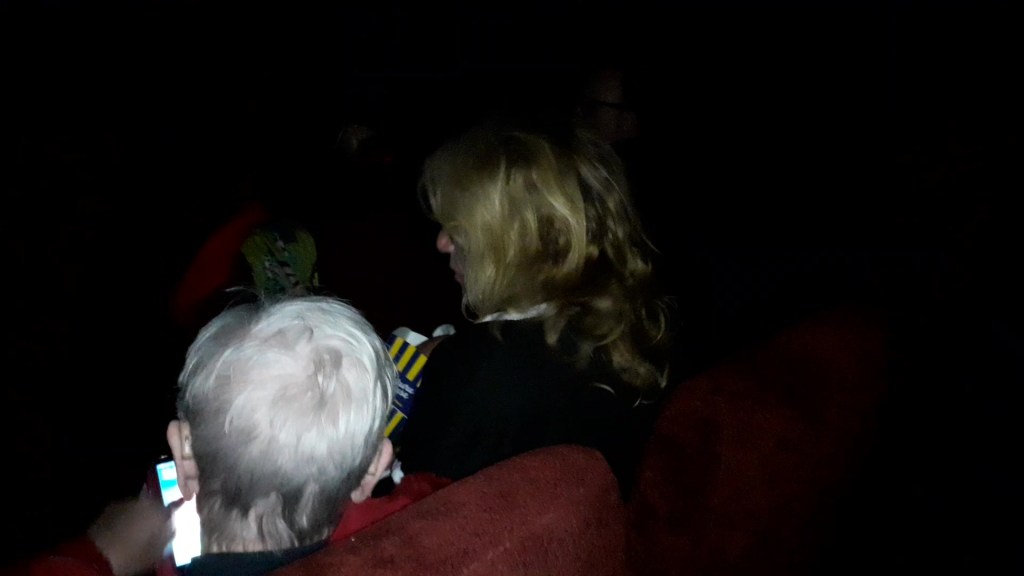
I make this point, because this film was easily the best attended of the many I’ve seen recently, and the audience was entirely composed of people like them. People who behaved in a way for which they would have excoriated anyone else doing the same.
The film is so full of indulgent luxury that you’d expect the odd, involuntary, chorused, ooh and aah, but not this lot. They said things like, ‘That’s like that dish that I was telling your sister about,’ or they’d giggle if they saw something like the cook cutting in half an entire bulb of garlic, as they realised the whole lot was going in; or they’d make schoolgirl noises as they watched the marrow squeezed from a bone. They giggled at quite a lot of things actually, never quite realising that they were watching erotica, not porn; that they were watching the very origins of all things great, not having imposed upon them gratuitous close ups of odd old-fashioned things, for which they had no stomach.
That’s the point. Apart from screeners arranged for chefs, English audiences may enjoy this film, but few of us will get it. Set in 1880s rural France, it wasn’t a history lesson in cooking, it was the formative moments of haute cuisine. As such, it feels as alien as Darwin’s laboratory to the English, and as familiar now, as then, to good French cooks.
You see, in England – and no, I haven’t conflated England with the UK, I mean England, I mostly mean that sois-disant haven of sophistication known as the south-east of England – there are more self-declared foodies per square mile than anywhere else on the planet. There are probably more Michelin starred restaurants in London than in any other city in the world. If there is a country which devotes more TV time to cooking, and in particular high-end cooking for smart people, I’d like not to have to spend a lockdown there. If there is a country that sells more cook books per head than England, it will have no remaining forests. If there are more restaurants per capita that charge above the average world price for a dining out experience, anywhere other than this little corner of the world, I’ll offer to prepare every meal for a year for the first person to tell me where that is.
I had the good fortune to live in France, the country in which this film was set, for five years. And I can tell you that la bouffe, la vie a table, la cuisine, runs through the veins of every one of its citizens. As far as gastronomy is concerned, they are light years ahead of the English. Fifteen-year-old boys would be embarrassed to turn out the book-learnt slop served up in many of the middle-class dinner parties taking place on Saturday nights in Greater London and the Home Counties. I don’t say that by way of some form of stretched synecdoche, but as an actual lived experience. I don’t know a single village in France that does not have a really good restaurant. You could walk into the most garish, neon-lit, perspex and plastic nightmare of a venue, and receive the best meal you’d eat all year. You definitely wouldn’t get a bad one. But, on the other hand, you could go to the grandest place in town in the south-east of England, pay astronomical prices for the privilege, and receive a dinner that wasn’t even cooked properly. The chef falls ill in England, and the place stops working. The same happens in France, and someone waiting their turn, steps up. Again, not said for effect, but lived and experienced, on both sides of the channel.
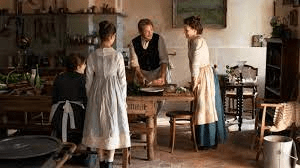
The way this audience of faux sophisticates gawped and erred through the film told you everything you needed to know about their ignorance as wannabee gastronomes.
For in England, this is us. This is what the successful middle classes look like – moneyed because they were careful, not successful because they had a flair for their subject. They jumped on the conveyor belt early in their lives, and never dared jump down again. They are safe. They are sharp elbowed, prominent jawed, me-first aspirants, who care nothing for the journey and everything for the label. I’ve met people at parties who, without irony, have described themselves as foodies, or bon-vivants, and boasted that they sometimes fly to different parts of the continent at the weekend, ‘Just for a meal,’ like that act alone rendered them sophisticated. They say these things out loud, in their expensive, ill-fitting, clothes, with their poor manners and forced charm, bereft of a sense of humour, incapable, ever to know what passion actually feels like, because they’ve spent their lives living at a safe distance from any such thing. They’ve never bothered to learn the foundations of what they claim to be their passion. They only know the end the result; the thing that you show off about; not how to create it, themselves; or even how to watch someone else do it, and understand what it is they’re doing, and why. Their pretensions are built on a house of sand. Their version of sophistication, something the English have always possessed in spades, its other name is snobbism.
For middle England is about as sophisticated as an Andre Rieux concert; and its middle-class are ignorant, rude, self-centred, ill-mannered, pretentious phonies who, in a blind tasting, could not tell the difference between a jar of cockles and a bucket of cocks.
Cubby Begge
Face eggs forward
 Dickie White's Diary
I think I was in that screening.
LikeLike