
Zone of Interest 8.5/10. A film without a great deal of dialogue, and a de minimis score, but with a constant industrial hum, and voices off, which tell you everything about the horror that’s going on, over the wall, at the bottom of the garden. The principals, Rudolf Höss, the SS camp commandant at Auschwitz, and his wife (Sandra Huller – also of Anatomy of a Fall), somehow tune it out of their otherwise idyllic lives. Höss loves his children, and animals, and he has a special love for the horse on which he rides out of the gates of his property, directly into work, each morning. Yet he keeps his position, and earns his living, by turning humans into corpses; somehow, for these particular humans, only concerned about the logistics of how to process them through his factory of death by the thousand. But it is his wife, who best captures the very essence of this film – living her life in blithe indifference to the unspeakable horror over which her husband presides next door. It’s a film that, like no other, stays with you long after the watching.
The Taste of Things 9/10. Anatomy of a Fall was chosen over this as France’s best film of last year, which, at this moment, I think is wrong. I suppose, at some moment in the future, we might come to think of this as we might a great meal we once ate together, that it was very nice while it lasted, but, of which, very few details can be recalled. I see that. But I still disagree. What is a film, but a visual experience? This opens with a thirty-five-minute scene, without dialogue. Normally, such things put a strain on the viewer. I know that films generally open without dialogue, but in most, if they don’t start speaking within five-minutes I start to get anxious, which turns into a blind rage of impatience within a few minutes after that, until eventually, I’m like a monkey, scratching for an opium-hit, desperate for them to put us out of our misery and start talking. But not here. As Juliette Binoche’s Eugenie meticulously assembles a five-course-meal of sumptuous extravagance, you become transfixed, like a glassy-eyed, salivating, devotee, wishing only that you could somehow melt into the screen and join in. And so, the film goes; the creative skills of the gourmand chef exposed as every bit as layered and nuanced as the smitten lover, finding new ways to woo his darling. Set mostly in the scullery, and largely in the preparation of culinary masterpieces, the film also embraces nature, friends, wildlife, horticulture, animal husbandry; the seasons, the outdoors, love, loss, and the promise of the future; bringing them all together, à table. And in this way, it makes its point, that to love any aspect of life so deeply that through it, you access the numinous, is really, to embrace a profound love of all life, and all its joys, thoroughly, wholly and completely.
There is a different type of review here [https://dickiewhitesdiary.com/2024/02/21/the-taste-of-things-to-come-is-just-the-way-it-always-was/]
Saltburn 3/10. Not quite as bad as Miller’s Girl (see below) but pretty close. A really poor film, not so much heavy with clichés, as much as, if it had no clichés, there’d be nothing of it left. It felt like a fan-girl’s homily. Miller’s Girl was made by Jade Halley Bartlett. I know that double-barrel names are no longer markers of wealth and breeding these days; Jade may be privileged; Emerald Fennell whose name will always be attached to this monumentally embarrassing mistake of a project, is a person of wealth. Unfortunately though, not of taste. Both Jade and Emerald, seem somehow envious of the work of great writers and film makers, and have attempted to mirror their brilliance. The result, in both cases, comes over as no better than the vanity projects of well-funded, wannabee, amateurs.
[see here for a longer review: https://dickiewhitesdiary.com/2024/01/19/theres-no-soothing-balm-for-saltburn/]
The Holdovers 9/10. A character driven, mid-range story, by the same people that made Sideways. What else need I say? Perhaps just to remind you of Tolstoy’s observation, that all unhappy people (sic) are unhappy in their own way. And that’s the way it’ll always be, you might add. I don’t know whether you share this POV with me, but I really hate the conceit of film -buffs, -makers, -gatekeepers to makers, that all stories, to work, require a character development, that amounts to an epiphany. What about something real, instead? Something where the characters remain the same, but share an interaction in the two hours we spend with them? One where there is no dawning revelation; and especially one, where the film does not end with one of the characters profusely thanking one of the others for the great sacrifice they’ve made. Well, this year we’ve been spoilt; first there was Zone of Interest, and then there was this film. Here, the three principal characters are roughly the same curmudgeonly arseholes at the end of the film, that they were at the start. They just know each other a bit better. Yes, as a consequence of all that, one of them has done something for one of the others, but no more than he might have done, had we asked him in the right way at the beginning. All that’s happened, is that we know them a bit better than we once did, and we discover that the part of them that resides slightly under the skin is more interesting than the version of themselves that they present to the world. Just great.
Anatomy of a Fall 7.5/10 Many things to love about this 2nd best French movie of the year – told mostly in English, but partly in French and German, with a stellar debut as the visually impaired 11-year-old, son Daniel (Milo Machado-Graner), who is the only witness to the ‘fall’. It is a film about not knowing. You have to be in a relationship to know what is wrong with it. You have to be a party to a trial to know what the truth really is. Third parties, and skilled cross-examiners can’t get at it. All they can do is point the adversaries at each other, and cherry pick misleading examples to make their case. We still don’t know, by the end the film, who did what, and who’s to blame. But we do know that life is complicated, and difficult, and that two different persons’ version of the same thing, experienced at the same time, might not align at all. We’ve always, sort of known that, haven’t we? It’s just that nobody has presented it to us in a film in this way, until now.
Rye Lane 8/10. Debut director, Raine Allen-Miller on the other hand (other hand? 😉– see Miller’s Girl and Saltburn) does with this film everything that a novice film maker should be doing. It will be called a romcom, but it’s so much more than that. It’s cute, it’s sharp, it’s wry; it makes clever jokes and observations, it has a cool and funny script that’s always going somewhere. It’s film-set London, but the rarely seen, not as photogenic (ugly), south-east London. It’s an adventure, a mini-odyssey, that’s light on its feet, without ever threatening to turn into On the Town. And there are semi-musical interludes, without ever threatening to turn the film into Moulin Rouge. It’s its own piece. Confidently handled, deftly presented, and get this, all you new-generation film makers out there, not up itself.
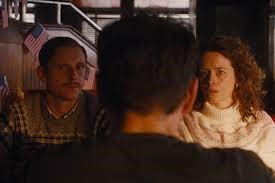
All of Us Strangers 8.5/10. A film of longing and love, delivered as a fantasy. We know it’s a fantasy because the, as ever, sublime Andrew Scott’s, character, is trying to write about the event that has defined and scarred him, as a screenplay; and he constantly meets his parents as today’s adult, even though they died when he was twelve years old. In his loneliness and despair, glaring into the abyss of the solitary old age which awaits him, he finds solace in love, from a neighbour in his otherwise vacant tower block, who has sought him out. Until…, finally, we discover something about that neighbour that tells us that we have lived in Scott’s fantasy from the very beginning. Almost an ensemble piece, it could be awful in the wrong hands, but with this cast, it sometimes flirts with perfection.
Wonka 8/10. The Willy Wonka bildungsroman, eh? It’s probably because, uber-confident of his craft, Paul King (of Paddington) got hold of this, that it is such a perfect presentation of a magical children’s story. Anyone else might have felt obliged to acknowledge Wonka’s creator, Roald Dahl and given Willy a little bit of a nasty streak. But not here. He is a 100% sweetie, but never saccharine, making this an event of pure pleasure to children, and grown-up children, alike. A criticism? It’s a musical (it is, even though they don’t let on in their marketing), and there are no great songs.
One Love 7/10. What can I say? It’s a bio-pic. Not a patch on last year’s Elvis, but nevertheless, all right. Fans will love it – I think I liked it in an above average way, even if it did rather present Bob Marley as a man with no faults. Who is it, Suchet as Poirot, or Olivier generally, who said, first you get the shoes, then the walk, then the rest all follows from there? Well Kingsley Ben-Adir certainly cracked the Marley gait. You don’t realise ‘til you see him on stage, but as soon as you do, you remember that Bob had a way of moving that was all his. Perhaps it was down to all the football he played? He has that footballers’ trademark, bow-legged, athleticism. The film is concerned with a short period of his life, where he goes from local politics, pop star, peace maker, who gets shot for his troubles, to exiled (London based) global superstar. Well cast, but it’s a bit Bob and Rita … and there’s a few Sues too, but my favs like Aston “family man” Barret, and Bunny Wailer, hardly got a line of dialogue. It’s almost a made-for-TV bio-pic in parts, but in the end, it manages to be better than that. And all done in an uncompromising, authentic, Jamaican patois, which I thought was the best part of it.
Society of Snow 7.5/10. Almost documentary in style, it makes a superb job of an horrific case. A story so well known, that even if you haven’t read the book, you probably knew about the cannibalism, to which the survivors had to resort to get through their ordeal. It chooses not to conjecture too much about the Lord of the Flies aftermath of that pivotal decision, preferring to keep closer to a Touching the Void vibe. Fascinating, harrowing, and demanding, it’s still a feat of story-telling, which holds you engrossed from the start to finish.
American Fiction 7/10. Noble aims; funny in parts. Generally good, and enjoyable, but ultimately too restricted by its own premise to ever get going as a film.
Killers of Flower Moon 6/10. A worthy story, and clearly a bit of a project for Scorsese, but it was two hours too long. The worst of it is, the essence of the story, when you get down to it, would have been perfect for a < 2-hour movie.
Napoleon 6/10. Films about Napoleon are a bit like that abandoned hotel on Cap d ’Antibes, (the Provencal?) which looks like the perfect development project, yet always renders each new owner bankrupt. Napoleon is such a worthy subject for the epic, but ultimately, there’s always just a bit too much to his story for ambitious film makers to put their arms around it all, and do it properly.
Despite scholars’ slagging of this movie for failing for all the same reasons that previous iterations have failed, I didn’t think it was too bad. I had perhaps been prepared for something far worse by the reviews which talked of endless, gory, smoke-filled battle scenes, which ended-up being nowhere near as long as promised. And the worst of the animal mutilation was got over in the opening minutes. Quite watchable really, and, when does Joaquin Phoenix ever not give you the very best version of a character that his prodigious talents allow? Mind you, I did have a little nap in the middle.
Miller’s Girl 2.5/10. Truly awful. Do not watch. Every cliché and hackneyed trope of the precocious teenager and the doting, err, conflicted, teacher. Felt like a teenager’s vanity project. Horribly miscast too.
Cubby Begge (a mere associate of Dickie White)
Face eggs forward
 Dickie White's Diary
Oh God, Saltburn. I’d looked forward to that for ages. And then, like you say, it was as if teenagers had been let loose with the dressing up box.
LikeLike
loooved A Taste of Things. & YES, how does derivative nonsense like Saltburn get made? And how come nobody notices that any good bits are ripped off from something else, and the remaining garbage is the original bits – Oh and (I’m on a roll now – thank you) the soundtrack! She gave it all away in the soundtrack, her cluelessness. It made me so angry watching that film; the finance it must have sucked up. Think of all the good films that weren’t made because of that!
LikeLiked by 1 person