
Don’t answer without thinking. Control your impetuosity. Deploy logic. Be normal. You might be suffering from something far more positive, like rock‑bottom self‑esteem; or the inability to get past your previous errors; or maybe you’re someone who’s summoned to a recurring doom‑loop of negative thoughts at 3:17 a.m. every night by a mind whose only commitment to you is to turn up on time. You might perhaps be someone who’s merely used up their entire life’s quota of luck within the first twenty-four hours of being alive. Any of these will do. You don’t need a diagnosis; you need a mirror. And Pity My Simplicity, the new novel by friend of the channel Hans Loë, is one of the most accurate mirrors you’ll ever see held up to the human psyche —unfortunately it’s one of those Perspex mirrors that you find in a motorway service station toilet. Or prison.
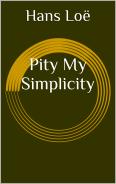
Now, before you stop reading: this is not one of those confessional mental‑health journeys written by someone who has discovered the healing power of cold showers, gratitude journaling, and how to be kind to yourself. Neither Hans —the author; nor Hans —the protagonist, ever uses the language of the self‑help aisle. They don’t name their condition. They don’t lean into vulnerability; they don’t reframe their narrative. They just live it, and drag you along with them, laughing all the way down to rock bottom.
Because this is the thing: Pity My Simplicity [https://amzn.eu/d/0fucT0D1] is, quite accidentally, one of the best self‑help books you’ll ever read. Not because it helps, but because it refuses to.
Hans Somes, our narrator, has just been released from a year of captivity. He was abducted by mistake —a clerical error in the kidnapping industry —and kept in solitary confinement long enough for his mind to fold in on itself like rotting melon. But the truth is, he may have been having a breakdown long before he was taken. He was homeless before he was abducted. He was hopeless before he was homeless. And now he’s back, wandering through the world like a secular Old Testament prophet, blown this way and that by the zing! of coincidences he follows as his guiding star.
This is where the self‑help angle comes in. Most books in this genre promise to train you out of your negative thought cycles. Hans Somes lovingly straps you back into them. He wakes up each morning and immediately resumes the doom‑loop: the humiliations, the wrong turns, the sliding‑doors moments that always slide shut on his fingers. He is the very definition of a high‑functioning depressive, except the functioning part is debatable.
And yet —and this is the miracle, he is hilarious. Every page is funny. Not wry smile funny; not oh, that’s clever funny. I mean laugh‑out, daft funny. His mind is a carnival of riffs, references, and cross‑wired cultural associations —and every so often he’ll coin a neologism so astutely on point, you feel personally indicted for having never named that particular misery yourself. He lives partly in the folklore, proverbs, and moral reflexes of the seaside elders whose voices formed the background noise of his childhood, and whose sayings became his instinctive vocabulary; partly in the texts of the English canon; and partly in whatever associative back‑alleys his mind wanders down that day. All of it arrives in a seamless lyrical refrain —it never jars or sounds pretentious. I’d gone on to the chapter following the one that conflates Great Expectations, a WWI music‑hall song, and Adlestrop into a simple slender thread before I’d even tuned into it. I defy any reader to recognise that it’s happening until it’s over. It’s like being mugged by a genius.
This is why the book works as self‑help: Hans knows exactly what’s wrong with him. He knows why he spirals. He knows the shape of his shame. He just can’t stop it. And in that honesty —that searing, unfiltered, untherapised honesty, there is something profoundly comforting about it. You feel seen. You feel understood. You feel, dare I say it, normal (you’ll have to read the novel to understand why that word is italicised).
But the real trick —the thing that lifts this book from great to how on earth did you pull that off? is the structure. The chapter numbers are wrong. When they switch to written titles, they’re even odder. Most of them don’t make sense; some seem to refer to his numbering system; others seem just to be placeholders; most of them appear to be the author’s “notes to self.” Some chapters repeat (well almost); some have virtually no words. One chapter is a brief letter from someone he doesn’t know, written for the sole purpose of delivering a brutal insult to Hans; unless it was a shame-laden reproduction of a letter he once sent to the BBC in an attempt to win a competition as a child? I couldn’t honestly say. Yet other chapters seem to anticipate a form of digital device that has the facility to hyperlink out of the rabbit hole into which he’s just taken us, back to the main story. They won’t work in a Kindle, and they look absurd in a paperback. Nevertheless…
At first you think: poor man, he can’t keep track. Then you think: oh God, he’s really losing it. Then you think: hang on… is this deliberate?
And then, in the final pages, the penny drops. The best last line in any novel ever written anywhere (I stand by this —but don’t go straight to it. It works because of what has gone before) reveals that what you’ve been reading is the first draft of the memoir Hans and his fellow hostage Keith once vowed to write. The chaos is the point. The disorder is the form. The failure is the art.
The sheer nerve of it. To present a novel that looks unfinished —because it is unfinished —and in doing so, to finish it perfectly. It’s like watching a man fall down a flight of stairs and land on his feet, bowing. A simple edit to the chapter headings and some minor excisions to his (acknowledged and confessed) digressions, and you have the final draft of the book in your hands. He knew this all along, of course; you only realise as you reach the last page. And all this, only moments after you’d assumed the novel’s great reveal came with Keith’s reappearance.
I loved this book. I loved the ride. I loved the way it made me feel less alone in my own doom‑loops. I loved the way it made me laugh at things I normally only cry about. And I loved the fact that I am roughly Hans’s age, and therefore recognised far too much of myself in his spirals.
It’s not all fun though, be prepared for desperate sadness too. I may well be the first person to cry at the death of an anorak in a novel, but I’m sure I won’t be the last.
I don’t know which Hans wrote this —the author or the protagonist. I suspect they don’t know either. But whichever one it was, he’s produced the most honest self‑help book ever written —because it’s written by someone who has absolutely no intention of helping himself.
 Dickie White's Diary
what causes pip in poultry?
LikeLike
you don’t have to be mentally ill to read this, but if you are it helps, eh?
LikeLike