I have been neglectful about keeping the story going. We left it, if you recall, as Friend John and I made our way from the loch where we’d dumped Iain “Bon-Bon” Colling’s top of the range four-door saloon, having, earlier that day, dumped Collings himself on a small island in the middle of another loch.
It took me back, that long silent walk through forests and remote country pathways, to the days when as teenagers, Neil and I did the same thing — hastily getting as much distance as we could, between us and the site of our misdemeanour; anxious not to be seen by anyone who might later turn witness.
Back in those days, we steadfastly followed one rule above all others —that should we encounter anyone on the way to the train, we would give them absolutely no opportunity to engage with us: no eye contact; no good mornings exchanged en passant; no pipe smoking; and no element of school uniform ever to be revealed in any circumstances. We made the most of our anoraks, and casual gear, to make ourselves look like ramblers, though then, like it does now, it always felt like we were stretching our meagre resources beyond breaking point, and easier to spot as offcomers.
Our main asset in achieving this, was to make a friend of silence. Animated conversations fall like confessions on foreign ears, and silence supported the image we wanted to present —that of dour hikers. We hardly ever met anyone at the time of morning at which we set out to return home, and on the rare occasions we did, we relied our purposeful demeanour to buy us a few crucial moments, before our fellow travellers stopped, and went, “Hold on a minute, two boyishly good-looking schoolboys out dogging at daybreak? What’s going on?” At which point, we banked on them thinking that their memory had played tricks with them, and that what they thought had been the innocent faces of youth, were no more than the pasty complexions of a pair of urban layabouts, malnourished and unhealthy by environmental deprivation, and actually a few years older than us, sent up from decadent squalor to recuperate in the countryside with a distant relative, out searching for unattainable stimuli.
We had a cover story ready to deploy if tackled though. It fed into this notion that we came from elsewhere, that by a family intervention we had been sent on a rest-cure to the Lake District, and we were ready to say, “mushrooming” to whatever question was thrown at us. It was sort of true anyway, though we made a point of not embarking on the homeward journey until we had come down from wherever it was, that Hawkwind had transported us to that night. Neil had spent a few terms in the scouts, and he had a rudimentary knowledge of bivouacking —which to us came to be known by another name: sleeping in unlocked sheds.
So, we did the same. We didn’t talk for fear of losing ourselves in the conversation, and so become neglectful of our discipline. And we made a pact that we would not talk until we next reached a tarmac road, and only then if that came, as we expected it to, five miles from our starting point, or more, which is I suppose, why I drifted off into memories of me and Neil, making similar journeys in similar surroundings, all those years ago.
There was a difference though. We were attempting to disguise our participation in illicit fun, albeit it felt like we’d done something wicked at the time —but, you know, no arseholes were hurt in the making of that video. This time, it was a crime scene we were fleeing.
Was it a crime? A real one? I mean, we hadn’t forced him on to the island, he’d swum over on his own volition as I recall. Mind you, Friend John had broken all his fingers just before he embarked on that swim —you have to take that into account to be fair, even if his broken fingers were a by-product of another negotiation and were justified in the context of that. Like him being an actual arsehole. And the car? Well, we just didn’t want it, and it was no good to him, we just disposed of it in a way that wouldn’t make it an eyesore. We’d probably get some credit to put against our sentences for that element of the event(s).
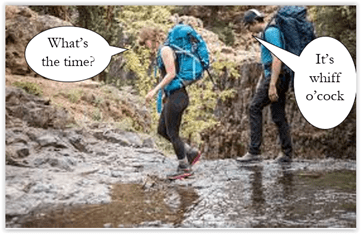
Some women hikers passed us going in the opposite direction. We’d walked about three or four miles by then. I know they didn’t see me. I stare too much. I know, it’s a thing I do. So, as soon as I sensed someone coming, I put my head down to put temptation beyond reach. I needn’t have. One of the them was wearing a vagina-profiling pair of yoga pants (they need a short-form reference -I’m going to exploit both versions of the “J” sound and call them va-j-oga pants). They draw you in those things. The form and all that, —like someone doing an Only Fans warm up for free, in public. I remember, I brought my hand up to my face as they came close. It was instinctive, anticipating that smell. But when it came to it, out there in the pine forest, holding my breath as they passed, I hardly noticed it. I don’t think I could have even identify her at a sniff parade, and, as you know, I’m half-dog. And despite the evidence too —you know, manmade fibres, tightness, exercise, proximity, and… err, seeping. Perhaps she was also wearing an ultra-absorbent panty liner? Though, I must confess, it’s hard to see where she’d have found the room to squeeze anything else in, down there.
“We should have said, hello,” I said. “We’ll be remembered for being abnormal.”
John wouldn’t have it; all sorts of nerdy socially inadequate weirdos went out walking. It’s why they did it, to ease their troubled minds. They’d meet much worse than us on their travels today, and they wouldn’t remember all of them, was basically the way he put it. I disagreed. We didn’t look like normal ramblers, and they, sort of, did. I mean, how do you end up hiking in va-j-oga pants, if you haven’t first tried all the standard kit?
“We’ve got backpacks,” he said. “You overthink things. Come on.”
We set off again, resuming our pact of silence.
He was right. I did.
I’d spent most of the time thinking about me and Neil. We are incapable as teenagers to comprehend how the rest of the world really does judge us —we seem just to assume that our self-image is universal. It had been so revelatory, on the way up here, when Bon-Bon and I, in the only moment of candour we’d ever shared since meeting each other aged five, had exchanged those observations —when he told me that for him, I’d always been someone who’d been over esteemed as a young boy, and continued to live in that bubble for the rest of my life.
I mean, he’s thick right. He’s objectively not intellectual; incapable of rationalising a philosophical argument. I am not clever, but I can wrangle with things like that better than he’ll ever be able to. He’s never read a challenging, let alone an improving, book, and yet he comes out with an observation like that! It so perceptive. I had been incapable, until that moment, to be able to see that in myself. Yet, when he said it, it struck me like a simple, cold, undeniable truth. It was like having an eighteen-inch blade that had been frozen in liquid nitrogen, deftly inserted through that black hole of anxiety, where your ribs join together, straight into the dead middle of your soul. And all of it done without an inkling of being attacked. Just a precise dissection, then left to bleed out alone as the realisation of the injury arrives too late to do anything about it.
He did that? What was it? A lifetime’s analysis which met with the perfect moment to deliver it? Pure malice, diluted into a few short sentences, that by coincidence just fell out right? The plagiarising of someone else’s work, that accidentally found a perfect fit and a choice moment? I can see that, I suppose.
But you cannot deny that he’d identified it. Almost tapped into my essence. Those fleeting episodes somewhere between eight and twelve years old, where I was declared smart, thus defining my self-image for life —everything that supported it thereafter, to be believed; everything that contradicted it, to be dismissed as mistaken. He knew that I was that, before I did.
It’s true, I believed that genius would arrive on my tongue, just because it was ME. I would be given genius things to say, and do. I was somehow imbued with talent. I had the gene. Just like Trump: he believes that he possesses insights more perceptive than any expert on the simple grounds that they’re his. Are all sons of narcissists destined to become at least narcissist-lite?
Or do people like me and him share a feature of upbringing that is, thankfully, vanishingly rare: that in addition to our unearned reputation for being smart, we also possessed tyrants for fathers, for whom we’d never be enough —that rare breed of men comprised of the most poisonous of cocktails.
The va-j-oga pant in human form! Our transparent delusions exposed for all the world to see what we’re really all about, too suffocated and stifled by our surroundings ever to disappear unnoticed, while we worked ourselves out and got our shit together. We were unable to escape the personality we’d been given; our father’s so disappointed, and yet so falsely proud of those unmerited epithets that had been neglectfully tossed our way, that they never ceased to train their spotlight on us.
Intelligence was our superpower. When we struggled with something, it was a subject that only interested stupid people, and plodders and pedants. We spent our lives avoiding failure like it was poisonous. Encounter something difficult and avoid it, lest you expose yourself as wanting. Always maintain the illusion.
We weren’t smarter, we just had the knack of passing tests better than some others, for a few years. That’s all. We all grew up, and they grew past us. How? Because they’d learned how to reason, and we believed that intelligence was a gift. We seemed to think that we were born knowing. If we didn’t know it instinctively, it wasn’t worth having. We learnt how not to work hard, and we never took on research —that was for those who needed to resort to being told what to do. We already knew it.
We were ashamed to say, “I don’t know.” So, when we came to face real problems, like getting a job, we suddenly realised that no one cares that you got an A in maths without revising, or that you winged it in English Literature, and they gave you an A for that too, because they’d detected a fellow genius in your writing. But our poor plodding peers, they could do things like that —they’d learned how to work things out. We stood in front of potential employers like social inadequates, lacking the skills to persuade someone we considered our inferior, to do so much as offer us a job.
And the result of all that? We spend our lives surrounding ourselves with half-wits so that we still look good, and aren’t challenged. And that’s why we hate everything. We’re incapable of cutting it at the level at which we think we belong, and so learn to live in this nether land, too big for it, yet too small to escape.
“What’s the matter with you? Stepped in something?” asked Friend John, as we hit the tarmac.
The change from the path back to the road was exactly as I remembered leaving the fell, to turn towards Foxfield Station. The railway line and the sea dead ahead, making it a T-Junction. In one direction: back to civilised conformity; the other an empty landscape in which you could go missing forever.
“Have you improved as an adult?” I asked John, as we set off down the road.
“Improved what?”
“You, personally. Are you a better version of what you once were?”
He shrugged inside his backpack, and I sensed it chafing his bony spine. “I guess so. You?”
I shook my head. “No, I’ve just realised. Every year since the age of twelve, I’ve got a little bit worse.”
He laughed, then realised that it wasn’t a joke.
“I’ve never done a single thing properly as an adult. Since aged sixteen, really. I only know how to fail. I seem to like that better.”
“It’s going to be a long journey back, isn’t it?” He said, edging closer to put his arm round my shoulders. Our backpacks clashed like teenagers’ teeth during their first kiss.
“Probably. Sorry.”
“Let’s start with breathing lessons,” he said.
I stepped back making a don’t worry motion with my hands, “I’m not having a panic attack.”
“I know,” he said. “I just want you to get the smell of those pants out of your system before we start.”
“You got it too? It was more of a feeling with me than an actual smell. Just the sense of one.”
John smiled, “Yeah, that’s the problem. You’re an overthinkist.”
“I am,” I said, “but I can’t stop now.”
“Well before we start any of that, I’m taking you down the Town Hall.”
What for? There wasn’t one. I thought we were travelling incognito. He noticed my face, screwed up in confusion.
“We were. But you’ve had your human rights violated, my friend, and we’re going to have to put that right before we go any further. We’re going to have to go and report it.”
He has. Had. A way of putting things in perspective did Friend John. I wish he was still here.
Next episode, how we found a fishing boat crewed by women in va-j-oga pants, and tried to persuade them to give us a job.


You’re not wrong. I’ve experienced one of those after a day in the field 😷🤢🤥
LikeLike