HIGH TIDE AND GREEN AS GRASS
-a reworking of The Brothers Grimm’s Snow White and the Seven Dwarfs, by Hans Loë–
Once upon a time, in the late spring of 2015, Roger, the controller of the News at Octopus Entertainment Services, was sat having his end of day tipple on the terrace of his Westchester County Manor house. He was feeling good about things. His show was doing well —advertising revenues were as high as they’d ever been; they were a shoo-in for at least one more Emmy this year; and even his grumpy boss, Rupert, in his latest call, had found nothing to shout about. Rupert was as close to happy as you could get him.
He sighed a contented sigh, and leaned back into his Lafuma Mobilier. As he did, he dropped his glass onto the terrace, spilling its entire contents. He got up from his chair to deal with the mess. He wasn’t angry, and he shrugged at himself to say, “these things happen. Just as well to get them out of the way while no one’s looking.” Then, as he bent down to retrieve the tumbler, which remained unbroken, he inhaled the aroma of the single malt, and a part of him registered the same enjoyment he’d have experienced had he drunk it. Beyond the pool of spilled whiskey, he noticed the vivid green of the strong spring grass. He didn’t describe it to himself thus, because he was poorly read, and essentially ignorant in that sense, “as thick as pig shit,” as Rupert often labelled him, but he was having a Proustian moment.
A few weeks later, a head-hunter rang him, “I want you to take a look at this guy, Roger. He’s as green as grass but the camera loves him,” he said. Roger told the agent to send the boy round to the studios for a screen test, but as soon as Roger clapped eyes on him, he knew he didn’t need to go through all that nonsense. He drew him in close with his trademark handshake, and caught a whiff of that single malt again.
“What do they call you, boy?” he said to the greenhorn that stood before him.
“Hogshead, sir,” said the boy. “Pete Hogshead.”
“What do you know?” asked Roger, and young Hogshead replied:
“Not a lot sir, some army. Some sports. Oh, and God, obviously. I’ve got a tattoo that explains it all.”
“Hogshead,” said Roger. “You’ll do just fine. Come on in. But in here, it’s the media, and if you’re pretty, and you work for one of the big bosses, like me, you’ll be called she. It’s just the way we do it round here. All assistants are trad wives.”
Hogshead’s smile crumpled on his lips.
“Don’t worry, love,” said Roger. “It’s only ‘til you make it. And even then… Rupert does it to me still. Look at me, I’m no worse for it. I get tons of action.”
Hogshead regained his smile, “What’s in a name?” she said. “That can’t harm me. It’s being on television that counts.”
Getting on for a year or so later, Rupert who, unlike the real king, exercised all the powers of an actual monarch, fired Roger. Mainly because he was getting on his nerves, though it was also in part because he was useless at covering up his peccadillos, and particularly bad at getting other people to lie for him. That was just plain incompetent for a high-ranking TV executive, and it brought far too much attention to Rupert’s most beloved cash cow, Octopus.
And Roger had been so infuriated by his sacking that he went and died, to teach King Rupert a lesson.
The sacking had caused enough upheaval, but there was no coming back from a death, so Rupert set out to find another bitch, which had been his pet name for Roger. He, himself, mighty Rupert, had been forced to step in to cover Roger’s absence, and that had gone on long enough already. As much as he was a great media tycoon, he was no sort of executive.
But nor was the man that Rupert wanted as Roger’s replacement. He disliked Donald intensely, but he knew that he had the sort of personality that chimed well with a section of his audience —the part that Rupert could never quite find a way to connect with. The way he figured it, Donald would create such a furore as the new face of Octopus that they’d no longer need an executive of Roger’s standing. A junior promotion from within would suffice. Donald wouldn’t listen to a man like Roger even if a new one could be found, and Rupert backed his tycoon’s instincts, to say that Donald would create more revenue than he cost to manage.
Nor did Donald think of himself as a replacement for Roger either. He was photogenic, and Roger had been a behind the scenes man. It was just as well, because that sort of competition would not do with Donald. Nevertheless, despite the differences between him, and the last face of Octopus, the wider media reported it all as Rupert’s next business marriage; one that they said came in short order after the last.
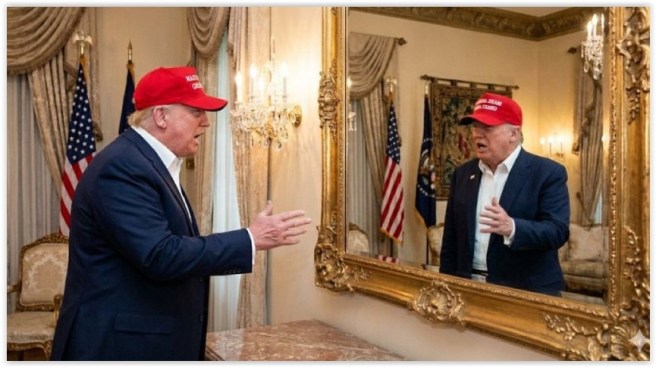
Donald brought with him a wonderful mirror when he arrived at his new place of business. It was his greatest ally, and closest confidante. Rupert laughed when he heard that Donald had insisted on that mirror taking pride of place alone, in the centre of the longest wall, in the largest, private dressing room in the entire Octopus estate. He shrugged as if to say “Let him have it his way,” when asked permission to take down the Jeff Koons collection from the wall. “What’s so precious to him about an ancient mirror?” he asked, “unless it’s so cracked, he can’t see his fat, ugly mug clearly!”
The assistant dared not say that Donald had brought an object that he believed was compelled to tell the truth, into Rupert’s offices. For Rupert did not know that when Donald stepped before it, he would ask:
“Mirror, mirror, on the wall,
Who is the fairest of us all?”
And his mirror, though it was loyal to him, had been acquired from a pure-blood Southern Baptist home, and had been raised to tell the truth, would reply:
“Thou art the fairest, you big Queen.”
Or words to that effect. It could speak frankly to Donald, because he made sure that they always spoke in private.
Mostly, it reassured him. But sometimes it warned him of threats to his status of New York’s most eligible bachelor.
As little Hogshead grew older, the more she grew into her looks, and it took only a little while anchoring shows on Rupert’s flagship station, for her to have mastered the art of makeup. Soon, her colleagues would remark of her complexion that it was, “as clear as moonlight;” and of her finely drawn jaw —“like a Hollywood actor.” And they would chorus of her hair, “That it was just like Ronald Reagan’s own. But better.” It must be all the liquids she takes, they thought, for to them, she always appeared thirsty. “Unless it’s an elixir, she takes,” said one, “she’s always glugging down something or other from that paper bag.”
There was no doubt about it, and it became a widely held view. Soon, for many of their viewers, Hogshead was considered better looking than Donald himself.
When Donald heard of this, he went to his mirror to ask:
Mirror, mirror, on the wall,
Who is the fairest of us all?
And it replied:
Donald was fairest yesterday;
but Hogshead is the fairest, now, they say.
The answer so angered Donald, that his natural orange hue instantly turned a burnt umber. From that hour, whenever he caught sight of Hogshead, his heart was hardened against her. Soon he hated the lightweight, fill-in presenter. He had become Rupert’s rising star. He knew that Hogshead had been recruited by Rupert’s bitch, the mere Roger Ailes, as Donald referred to him, and now, it felt like she, rather than Donald, would be seen as true lineage of the Octopus brand. “Not while I’m around,” Donald thought to himself.
“Hogshead is only fit for a coffee klatch on The View, he’d shout at the TV screens dotted about the estate. Turn it off.” Which was a very alarming thing to hear for his close attendants, for it was considered a fact that Donald might die if ever there was a TV set not playing somewhere within his earshot.
His envy and jealousy increased, so that he had no rest, day, or night, until finally, he called Tom Huntsman to him and said, “Take that upstart away into the forest. I will never look upon her again. You must kill her, and bring me her heart, tongue, and entrails as a token to prove you’d done the deed. And then,” he added, “I will devour it all, to prove that she is gone forever,” whilst secretly thinking to himself, that if he got a bit of Hogshead’s DNA in him, it would assist the preservation of his own good looks.
Tom Huntsman listened, but he did not know how to listen and remember at the same time, so he asked Donald to repeat his instructions, and then again. Donald refused to write his commands down, but instead, pointed at Hogshead on the television, and made a gesture with the index finger of his right hand, thrusting it into a ring he made of his thumb and index finger of his left.
Hogshead was pretty, sure, but Donald would not have meant for him, Tom Huntsman, a man’s man if ever there was one, to carry out such an intimate act with someone, who despite all that was said, resembled a male, more than she did a female. So, he took the little parvenu away with him, and made sure to pack his best knife —the one he used to deal with offcomers who came uninvited into Rupert’s fiefdom in the dead of night. That was what Donald’s gesticulations had meant, wasn’t it? To stab Hogshead? It must be that, thought Huntsman, because otherwise all that stuff about the entrails wouldn’t make sense.
He dragged little Hogshead into the cold dark centre of the scary forest, but when he drew out his knife to kill her, she began to cry, saying, “No, dear Tom, give me my life! I will run into the wild forest beyond this one, and never come home again.”
“Just a minute,” said Huntsman. “You’re telling me they don’t have TV Networks over there that you’ll join and squeal on us, and all we do here?”
Hogshead reassured him, “Mr Tom, they don’t even have TV sets there. That’s why it’s called the wild forest. It’s even worse than the one we’re in. I’ll make a new life there; one where our fun is restricted to celebrating May Day, and Independence, and Thanksgiving. That and the bible readings will be plenty enough for me. Please spare me.”
“Sounds purty good,” said Huntsman to himself, and though he was inclined to help her after such a plea, he couldn’t help but think that by releasing her, he was only deferring her sentence, and that the wild animals of the forest would carry out his work for him.
“Run away then, you little thing,” he said, releasing her. And as she made good her escape, he couldn’t help but think to himself, “That little flitty witty has probably never even been in the boys’ brigade, let alone the regular army.”
It felt as if a stone had been lifted from his heart, because her inevitable death would not be by his hand. And just to confirm him in his thoughts, at that very moment, a young boar came roaring along to the spot. He looked for signs to see if Hogshead had been devoured by the animal, and seeing none, suddenly panicked as he realised that he was to be its prey! Quickly, because base hunter gatherer instincts were not so much his best, as his only skill, he drew his favourite knife from its scabbard and slaughtered the beast, before it did the same to him.
Hogshead hadn’t heard the noise, or if she had, she’d run further and harder in the opposite direction. And so, seeing no one around, Tom crept quietly out of the forest.
It was only when he reached the forest’s edge, that he realised his opportunity. The beast’s offal would serve as the proof Donald had demanded for the despatching of Hogshead. Life was challenging when you could only retain one thought at a time, and, as a consequence it moved slowly for the likes of Tom Huntsman. Fully three days later, he returned to the HQ at Octopus, and presented Donald with the foul smelling and rotten meat. But the transaction took place in Donald’s dressing room, so no one noticed.
Only now, poor little Hogshead was left without so much as a guardian to look over her. She was suddenly quite alone in the world. Overcome with grief, and bewildered at the sight of so many trees, she knew not which way to turn. On hearing the sounds of the stricken boar, she ran till her feet refused to go any further.
Then, just as it was getting dark, she saw a little house in the distance. She approached it quietly, careful with her dainty steps to avoid snapping a twig, lest she alerted the occupants. She had decided that she would first seek out an outbuilding in which to rest for the night, but approaching closer, she could see that there were no lights on; closer still, and there was no noise of any kind; right to the front door, and not even a hint of movement from within. She pushed gently at the door, and to her surprise, it swung open. She decided to take her chance, and went inside.
In she went, on tiptoe, holding her breath, trying with all her might not to make the slightest noise. She walked on the joins between floorboards so that they wouldn’t creek. But it was so very difficult, for this cottage was so tiny, and everything in it, the same. Yet, she could see, it was all so very neat and elegant too.
In the middle stood a little table with a white cloth over it, and seven little plates upon it, each plate having a spoon and a knife and a fork, and there were seven little mugs standing neatly alongside all of those place settings. Against the wall were seven beds, equally small, arranged in a row, each covered with snow-white sheets.
For a moment, his mind flashed to dormitory of the Venture Scouts, then back to the hunting knife, and the aroma of the forest. He swooned, telling herself it was fatigue, not fear. That elder boy, who looked gruff like Huntsman, he’d called him a girl’s name that night too.
But those days were behind him, her, whatever he was. Yes, he was hungry and thirsty, but mainly thirsty. He ate a morsel of porridge out of each plate, and drank a drop or two of wine from each mug. Not only had little Hogshead learnt the rules of stealth attacks in a video on YouTube, and did not want to alert anyone to her presence, he’d also learned back in the scouting days that if you just took a bit from each bottle, nobody noticed that they were going down.
After that, because she was so tired, she laid herself down on a bed, but it did not suit; she tried another, but that was too short; a fourth, she stubbed her toe on the orange box that stood alongside it and took against it; a fifth was too hard; the sixth, like sleeping on a cloud. The seventh though, was just the thing, and saying her prayers first, an hour or so later, she tucked herself in all round, then went to sleep.
When it became quite dark, the owners of the cottage came home: seven dwarfs, who mined for precious metals in the nearby valleys. They first lighted seven little lamps, and saw at once —for they lit up the whole room, that somebody had been in, and that everything was not in the order in which they had left it.
Jip Bezo asked, “Who’s been sitting on my chair?”
Sam Half-Man said, “Who’s been eating off my plate?”
Bri-Ny Chismie said, “Who’s been nibbling at my bread?”
Ma-Ma: “Who’s been at my porridge?”
Bentley Ho: “Who’s been using my fork?”
Zitty Pop grumbled, “Who’s been cutting with my knife?”
And Travvy Nicknack said, “And who has been drinking out of my mug?”
Then Zitty, looking round, began again, “Who has been lying on my bed?” pointing at his tangled sheets. At these words the others came, and looking at their beds cried out too, “Someone has been lying in our beds!” But Travvy Nicknack, running up to his, saw Hogshead sleeping in it. He called his companions, who held up their seven lamps so that the light fell upon the little sleeping form.
“Oh, heavens! Oh heavens!” said they; “what a beauty it is!” and they were so much delighted that they would not awaken the sleeping form, but left it to sleep. And Nicknack, in whose bed it was, slept with each of his fellows one hour, and so passed the night that way.
“It’s a good job that the giant, Peter Teapot, isn’t here on a night like this,” said Bentley Ho just before he dropped off to sleep. It set all the other dwarfs off giggling, and they feared that they’d wake little Hogshead. But whatever it was, lying next to them, in their beds, was dead to the world.
As soon as morning dawned, Hogshead awoke, and was quite frightened at first on seeing the seven strange little men; but they were very friendly.
He bounced out of bed, and realised at once that he was about two feet taller than almost all of them. “Right,” he said to himself, “First thing I’m doing, is getting my pronouns back.”
“My name is Hogshead,” he replied. “Pete. I know that I’m tough looking and all that, but I am also compassionate, so don’t worry, I won’t go round hazing you, and all that sort of stuff for being ridiculously small, and basically too little to be of any use to anyone.”
“What do you do?” asked Ma-Ma.
“I’m in the army,” said Hogshead.
Jip started laughing. “No, you’re not, we’ve seen you on the TV in our office.”
“I’m the army’s representative on TV, for your business,” said Hogshead. “Anyhow, what do you do?”
The dwarfs told him how they went down into the valley each day, to mine for precious things, and make themselves rich.
“Rich?” laughed Hogshead. “Dressed like that. Look at me, how smart I am, and I live on a mere army stipend.”
“I thought he was a TV presenter,” whispered Chismie to Sam Half-Man. Sam Half-Man shrugged. He didn’t like to speak. Every time he’d tried it, the words came out wrong.
Jip told Hogshead that it was important that they all dressed like the common people they represented —the ones who sent them what they could spare from their earnings, to help fund the mining business. “We don’t want them to resent us our riches,” he said.
“One of everything. All lined up neat? All frugal. Yet rich? What is this, a fairytale, or a story for the account?” thought Pete. His training had taught him to appraise situations and have them summed up in seconds, like Jason Bourne, at the movies.
Pete Hogshead looked confused. “So how come, if you’re so rich you all live together, then?” he asked.
The dwarfs started laughing, and each one’s laughter encouraged the others all the more, until in the end they couldn’t stop. Eventually, they calmed down, and Ma-Ma said to Hogshead, “We’re bro’s, we get all our great new ideas by living in the same space like this, creating, inspiring, sharing —like The Beatles. Everyone knows it’s how all great businesses like ours begin; we’ve just turned it into a permanent thing.”
“I don’t like the sound of that,” said Hogshead. “In the army, it’s every man for himself, all of us being as violent as we possibly can.”
It brought a silence to the group of dwarfs. None of them knew quite what to say. Eventually Chismie ventured, “You know, if you used technology, you’d learn the benefits of teamwork.” But that made Pete frown all the more.
“And the tactical advantages it brought would mean that you could win battles and wars from your office, at a computer terminal.”
Pete laughed now. “Fighting technology should have stopped with the musket and the bow and arrow, when we conquered this land given to us by God,” he said.
Now the dwarfs really didn’t know what to say. They each looked at the ground, and this time, nobody stepped forward to contradict to Pete because he looked so fierce when he said it. Some of them went to make their beds, others started to pull on their work clothes.
“So, why have you come into our cottage?” asked Jip, pulling his overalls over his shoulders.
“Jesus,” thought Pete. “What an earnest pain in the arse that little pipsqueak is. Would it harm in to let things go once in a while? He’d last about five minutes on Octopus.”
Pete gestured for them to sit a while on the edge of their beds, then he told them how Donald tried to have him killed, and how the Huntsman had spared his life, “It’s true, I saw his big chopper sticking out, and I was thinking that he was going to put it in me. Well, I was sure he was. It happened once at Venture Scouts, and when I saw that thing, I started struggling, and even though he’s twice the size of me, and does PT every day, I got away,” he said. Then he told them about how he had wandered around for the rest of the day, lost and alone, but not that frightened, because of all the training he’d done. And how he had been about to create a compass out of twigs on the old pond in the middle of the forest, when a bear came by and he’d had to take cover, and whilst doing so, saw their little cottage.”
The dwarfs looked at each other, “Bears? In our wood?”
Pete went on, “What needs to happen now, is for you all to take up strategic positions around the edge of the forest, and provide me with cover fire until I can pick up the trail back to the Octopus estate. I’ll need to take a couple of you with me. We’re going to raze that place, and everyone in it.”
As one the dwarfs shook their heads. The tax they paid through their nominal headquarters in the Cayman Islands, meant that other people did those sorts of things for them. Their role was to keep the furnace stoked at home.
Ma-ma spoke. “I think you may be the person they mentioned on the news yesterday,” he said. “They’re sending an ICE patrol out to these woods, to search for you. There are reports that you’ve gone missing, and you were last seen hereabouts.”
“If I meet those guys out in the open, I’ll get creamed. Worse, they’ll mess up my face, and I need that.”
Poor little Pete suddenly looked very forlorn. He held his head in his hands, pondering, “I’ve trained with most of them. They’re bad MFs!”
“Mountain Foresters,” Bently Ho explained to Zitty, who looked on the verge of tears himself.
“I’ll tell you what,” said Ma-ma. “If you were to look after our household —pretend to be our cook, make the beds, wash, sew, and knit for us, and keep everything in neat order, we’ll keep you here, and you shall want for nothing until all this passes.”
Hogshead thought for a moment, then answered, “Yes, I was in the catering and housekeeping corps of the army. I excel at such tasks, and got a badge of excellence for them.”
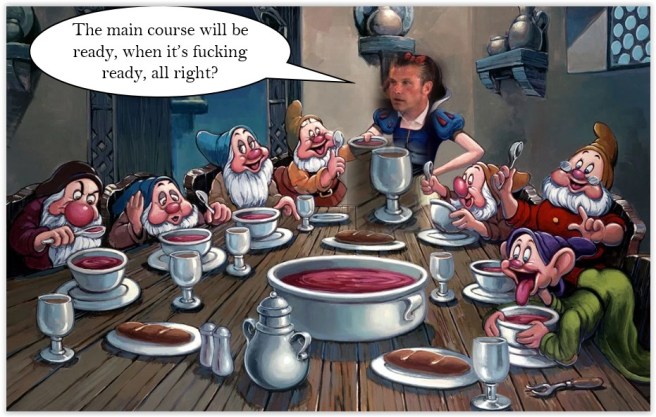
And so, he remained with them, and kept their house in order. In the morning the dwarfs went into the valleys and mined for their precious things; and in the evening, they came home and found their meals ready for them. During the day, little Hogshead was left alone, and therefore the good dwarfs warned him, saying, “Be careful of Donald, who will soon know of your being here. Let nobody enter the cottage.”
To which Jip added, “Especially when you’ve been using the cooking sherry.” For as much as little Jip had one eye in Waco and one eye in Winchester, he was one for details, and he’d noticed how on some days, when wine or sherry had been added to the stew, that there was something that looked like little lumps of vomit floating in it.
.
Donald meanwhile, had changed things around at Octopus. He was the one who was there every day, shouting the odds, and having everyone bend to his bidding. In a certain sense, Rupert was happy too —he had no instinct for all that day-to-day executive management schtick; but in another way, he was disappointed. Such was Donald’s dominance, and his popularity with the lower quartiles of Octopus’s followers, many of them had started to say that Rupert was Donald’s bitch, and that it was Donald who called the shots. Like Wee Petie, he’d reclaimed his sex in no uncertain terms. No one referred to Donald as Rupert’s Queen anymore, even though sometimes, they secretly thought he was a bit precious about his appearance. No, he was Big Donald, the de-facto boss of Octopus these days.
He believed that he had eaten the insides taken from Hogshead’s corpse, and that he was once again the most beautiful creature in the world.
It had been him that had instructed Tom Huntsman to send his ICE patrol into the forest.
Huntsman had, at first, protested, telling Donald that he wouldn’t find a sign of Hogshead’s slain body, but Donald wouldn’t have it. He wanted all evidence of the killing destroyed, so that nothing associated Huntsman, and therefore him, with it.
“We’ll make it look like we’re concerned about a little helpless thing that’s gone missing,” he’d said. “Then we’ll call it off in a week or so, when we find nothing. Just send one of your ICE cream vans to do a couple of laps of the woods and forests. That’ll do it.”
Tom Huntsman obliged his boss, and gave the orders. But he knew that only bad could come of it were they to be thorough in their task. So, he sent his worst crew to the wrong place, telling them to have a brief scout about, then to come home as soon as the TV cameras had gone.
The eating had been a bit of an ordeal, for Donald liked his meals plain, bar the ketchup. He’d left orders for Hogshead’s offal to be minced down in a processor, and to be blended with regular outside meat, as he put it. In that way, his chef’s were to create burger patties of no more than fifteen percent offal content, or failing that twenty percent, because that was the way you went up at those low levels in business, Donald had told them. Twenty-five or thirty percent would have seen the insides of his former colleague disappear within a week or so, but at fifteen, then a few days later, twenty percent, the unsavoury meals lasted fully a fortnight.
He didn’t take well to being defied, but each time a new burger was put in front of him, he prayed that it was so. Had the kitchen spared him the liver burgers, as he referred to them, it would still have counted —Hogshead was dead, and something, somewhere, at HQ had devoured his organs, even if that was only the waste bin in the kitchen.
One day, a little while later, when the memory of the offal had receded, and the bathrooms at the Octopus Centre had been given a makeover, he plucked up the courage to step before his mirror again. The bloating had gone from the enforced diet now, and he was back closer to his fighting weight. He said to the mirror:
Mirror, mirror, on the wall,
Who is the fairest of us all?
and it replied:
Donald was fairest for a spell;
But Hogshead’s been spared from his hell,
The dwarfs protect him from thy sway
Amid the forest, far away.
Then, as Donald turned to throw a ketchup bottle at the serf leaving the room, shouting after him, “All you manual labourers aren’t worth the money we give you. You should pay to work for us, and be glad of it. Next time you come in here, bring your wage packet with you, otherwise get looking for another job,” the mirror added:
“Everyone’s talking about it;
It’s what they’re all saying.”
Although the information had surprised him, Donald knew this sort of language. Better than the mirror actually, and he knew that it spoke the truth. He knew, that Tom Huntsman had deceived him, and that Hogshead was still alive.
He called for his servants to be brought before him, and once they were lined up, he told them that he’d overlook their gross negligence in the performance of their duties, if they were to force-feed offal, or any rejected offcuts of meat they could get their hands on, to Tom Huntsman, here before his eyes this very afternoon, until he choked on it. Adding, that should they not find any, they were to elect one of their own who would have to donate their own, so that the task could be performed.
“I ate twenty-five liver burgers the other week for you lot, all because of that no-good liar. And someone here’s gonna make it up to me one way or another.”
A few days later, when Tom was dead and gone, and the newspapers had written up his death as an unfortunate indoor hunting incident, Donald called off the ICE patrols once and for all, believing them still to be in operation, then prepared himself for the next stage of his plan. He took the dye from his face, and clothed himself as an old tinker woman so that no one could recognise him, and in this disguise, he went over to the woods to search for the house of the seven dwarfs.
To maintain his masquerade, not to mention sparing himself the shame of being seen in drag so soon after all the talk of his marriage to Rupert, he drove himself to the forest. The satnav didn’t work as Donald had told it to, and as a consequence he only found the dwarfs’ cottage as twilight came, and the little workers were already heading for home.
He knocked at the door of their little dwelling, and called out, “Fine goods for sale! Beautiful goods! Really beautiful. Everyone’s talking about how beautiful they are. Best goods you can buy, miles cheaper than when that bum Roger Ailes was out hawking stuff that looked like these but were cheap replicas. Hear that! They were replicas and miles more expensive; these are the real deal. For nothing! We’re giving them away to our best viewers, and most loyal supporters. Even those who don’t like us anymore. The other lot were stealing off you; we’re giving you your money back.”
Hogshead peeped out of the window and said, “Good day, my good woman. What have you to sell?”
“Fine goods, beautiful goods!” she replied. “Really beautiful goods. Gym clothes. Sexy underwear they’re saying. I don’t, I’m a Christian; pure minded. Tight gym kit that holds you in, and makes everything look normal. I’ve got a set on now —vajoga pants. They hold and contain everything —gripping technology. Everyone says they’re the best you can get. And of all colours too, but mainly orange and gold.” And she held up a pair which were made of orange and brown nylon. “Like these golden ones. See how they shimmer? That’s ‘cos of the gold thread.”
“I may let in this honest woman,” thought Hogshead; and he unbolted the door. But before allowing her to cross the threshold, he made sure to bargain with her, that he could test them before committing to a purchase.
The old woman consented, and had Hogshead take off his shirt. Then she proceeded to stretch the two-times too small, rubber and Lycra top over Pete’s head, and pull it down over his tattooed torso. He was soon panting for air, but the old woman ignored his breathless protestations and went quickly to the shorts. They were the same, and the two of them struggled working together, to pull them on over his bulging thighs.
“Wrong way about!” the woman exclaimed.
“No, look, the drawstrings are at the front, as they’re supposed to be,” Hogshead wheezed —scarcely a breath of air remained in his lungs.
“Rubbish! That’s not how they work,” said the old woman.
Pete did as he was bidden, took off the shorts, then stretched them on again the other way round. The woman had him lie on the floor, face-down, as she pulled them up the final few inches, and Pete, almost a spent force by now, gave in to her exhortations, and let her do as she pleased. Once she had him there, she took the drawstrings in a firm grip, and placing her knee in the small of his back for extra leverage, started to pull them yet tighter.
Hogshead squealed a little as she yanked at the strings, striving to pull every last centimetre from them, but suspected nothing still —the boys in Venture Scouts got up to all sorts of hi-jinks like this; and so, he allowed her to do as she wished with his limp body, without complaint. But then, the old woman pulled the string so tightly that all his breath went, as if he’d downed a half-bottle of Jack all in one gulp, and he went limp on the floor, as if dead.
“Now,” thought the old woman to herself, hastening away, “perhaps I am, once more, the most beautiful of all!”
At eventide, not long after she had left, the seven dwarfs came home, and were much frightened at seeing their dear little maid lying on the ground, neither moving nor breathing, as if he were dead. They raised him up, and when they saw that he was laced too tightly, they cut the gym clothes to pieces, until, presently, he began to breathe again, and little by little he revived.
“It was a bit like the Navy Seals recruitment program, only a bit more difficult,” said Hogshead, as life came back to his body.
When the dwarfs heard what had taken place, they said, “The old tinker woman was no other than wicked Donald, your Octopus-mother. Take more care of yourself, and let no one enter when we are not with you.”
Meanwhile, Donald had reached home, and going before his mirror, he repeated his usual words:
Mirror, mirror, on the wall,
Who is the fairest of us all?
and it replied:
Donald was fairest for a while;
But Hogshead’s now regained his smile.
The dwarfs protect her still from you,
And all that you would seek to do.
As soon as the mirror stopped speaking, all of Donald’s blood seemed to rush to his heart at once, and set it racing. He was so angry to hear that Hogshead was still alive. It made his ankles swell into black puddings, and similar coloured blotches appeared on his hands. And then, a rash like syphilis, broke out on his neck, and on other bits of him that didn’t have proper names —some of them he’d grown himself; some of them were additions that his friend Elon had grafted on to the hanging-down parts of his body, to make it work better. Soon all of that was covered in the rash, and looked poxy.
In this state of fury at the world, his failing body, the dwarfs, Rupert, the dead Huntsman, but most of all Hogshead, he began to conjure with ideas for a new, even more dastardly, plan.
“I will make something which shall destroy him completely,” he shouted at the walls.
Thus saying, he called for a tub of goose fat, and when it was delivered, he went to his medicine cabinet and crushed up every drug he found in it, into a fine powder. Then he mixed the powder into the fat to make it the most poisonous but innocent looking concoction. Over the years, he’d taken many a different drug, and he knew the strong from the weak, and those of instant effect, from those which worked by slow release of their magic. What a potion he created, taking care to leave out all the aspirins, which he knew were so good for you they’d likely counteract all the fantastic poisons he’d put into the mix.
Dressing himself as a woman again, this time more like an Avon Lady than a tinker, making himself a bit more milfy-prostitutey than he was previously, he went again into the wild forest where stood the house of the seven dwarfs. Knocking at the door, he called out, “Good wares to sell to-day! Even better than last time.”
“Have you been here before?” asked Hogshead, peeping out from behind a curtain.
And the sexy middle-aged lady, the type wee Petie really liked, replied, “No. I said it just in case anyone had been round selling you shoddy goods for too much money. I’ve got the real deal here. Things that only billionaires further on down in the valley buy, but can’t get access to because I haven’t been there yet.”
Hogshead replied, “You must go farther, for I dare not let you in.”
“But still you may look,” said the lady, drawing out the jar of lotion and holding it up.
“What is it?” asked Hogshead, beguiled by the sight.
“Ointment,” said the lady.
“For rubbing in, after the gym?” asked Hogshead. “To the dry parts, and bits that crack?”
“Better,” said the lady, knowing that Hogshead valued his sweep of Ronald Reagan hair, more than he did any of his other physical attributes. “It’s hair ointment. A special, old-fashioned recipe that holds men’s hair like it did in the old days, when America was great.”
This news pleased Hogshead so much, that he opened the door.
“You’re such a lovely thing to look at, let me give you my best comb to go with it,” said the lady. “You can have it for a good price.”
“But I don’t have any money of my own, and I can’t afford the comb, whatever price you charge, let alone the jar of ointment,” said Hogshead. Then, in case the lady was a robber in disguise, he added, “they take all there is and hide it in the pockets of Jip’s space overalls, so that it can’t be stolen.”
The lady batted away Hogshead’s protestations. “When you see how well it works, you’ll want to keep it, and then you can ask your friends for some money when they come home this evening. I’ll pop back tomorrow, and you can pay me then.” So saying, she thrust the jar into Hogshead’s soft hands.
Scarcely was the first gloop of fat drawn through the hair, when the poison began to work, and Hogshead fell down senseless.
“You thing of beauty,” cried Donald, “not so pretty now, are you?” And seeing his foe defeated, he departed before the dwarfs arrived home.
Fortunately, they were on their way back already, for it was half-day closing in the valley of metals and precious items, and the seven dwarfs returned soon after Donald’s departure. As soon as they saw Hogshead lying upon the ground, to them dead, they suspected Donald. Discovering the poisoned ointment, they immediately washed it from his hair. It took several hours to get all the grease from his head, because there’d been a thick base coat to begin with, and the little dwarfs did not want to risk leaving any of the noxious ointment in his hair. When he was eventually revived, he told them all that had happened. So again, they warned him against the wicked Octopus-mother, and bade him open the door to nobody. “Not even Peter Teapot!” they told him. “No matter how angry he gets.”
Meanwhile, Donald, on his arrival home, again consulted the mirror, and received the same answer as twice before. It made him tremble and foam with rage and jealousy, and he swore that Hogshead should die, whatever the cost.
Thereupon he ordered the best burger the kitchen could make.
“You’ve let me down recently, making me eat all those liver burgers, today I want an eight-star Burj-Kalifa burger that would be served to an actual Arab king, or Tsar,” he said.
“But the Burj only goes up to seven, protested his chief chef.”
“For that, you can make me a nine-star burger,” shouted Donald, and slammed the phone down.
The burger soon arrived, and when it did, he went straight to the gardener’s hut, at the far end of the Octopus complex, taking with him a half-full bottle of ketchup. He filled it to the top with all manner of weed killers and poisons he found in there, then gave it a good shake. It looked so good, he was tempted to taste a little bit on his finger, but he fought that desire, and shuffled and swung his idle fat legs as fast as he could, to get himself back to his dressing room. In his private bathroom, he removed all the dye from his hair and face, and tying a headscarf that he’d stolen from an assistant’s handbag, around his head, he went out to the forest again, this time as a country peasant woman.
Soon he reached the dwarfs’ cottage, and knocking at the door, Hogshead opened it a crack, and leaning his head round it, said, “I dare not let anyone enter; the seven dwarfs have forbidden me.”
“That is for you to decide,” said the old woman, “for I know that you are stuck in there, cooking stews all day for the dwarfs when they return home, when all day they have eaten sushi, and all that other bullshit that office execs eat. Take this,” and she tried to hand Hogshead the juicy burger.
“No,” answered Hogshead; “I dare not take it.”
“What! are you afraid of it?” cried the peasant woman. “It’s not got any offal in it, or anything. It’s the sort that Arabs eat. Rich ones, with oil wells!”
Hogshead looked longingly at the burger. Droplets of saliva appeared at the corner of his mouth. “It is tempting,” he said, “for I have eaten nothing so good as that, all the time I’ve lived here. But no, I dare not, I’ve been on a terrible run of luck lately, all caused by taking things from strangers who come hawking at my door.”
“Tell you what I’ll do,” said Donald “I’ll cut the burger in half. I’ll take one and you take the other and we’ll enjoy it together.” He went ahead and sliced it into two perfect semi-circles, taking care to see that all the ketchup was on one half only. It was something of a commitment on his behalf to eat a burger without ketchup, and he hoped that Hogshead would acknowledge the sacrifice he was making.
“Is that not good?” Donald asked the poor little idiot.
Scarcely had Hogshead placed a piece in his mouth when he fell down dead upon the ground. Then Donald, looking at him with glittering eyes, and laughing bitterly, exclaimed, “It’s as if the soak has drunk a hogshead of wine! This time the dwarfs cannot revive you.”
When he reached home, he consulted his mirror—
Mirror, mirror, on the wall,
Who is the fairest of us all?
And it answered:
You are, you big Queen. I love you in your drag, so fey.
The Donald is the fairest of the day.
At last, his envious heart was at rest, as peacefully as any envious heart can rest.
When the little dwarfs toddled home in the evening, they found Hogshead lying on the ground, no life in his body, quite dead. They raised him up, and searched in vain to find anything poisonous. They unlaced him, and even washed his hair, then they washed him with water, and once they were sure that they could detect no liquor on his breath, cleaned him once more all over, in rubbing alcohol. But nothing availed: the dear boy was really and truly dead this time.
Then they laid him upon a bier, and all seven placed themselves around it, and wept and wept for three days without ceasing. Then they prepared to bury him. But yet, he looked still fresh and life-like, his tattoos gleamed as they ever had, his abs seemed tight and firm, so they said to one another, “We cannot bury him in the black ground.” So, they ordered a case to be made of glass. In this they could see the body on all sides, and the dwarfs wrote his name with golden letters upon the glass, saying that he was a protégé of the mighty Rupert. Now they placed the glass case upon the ledge on a rock, and one of them always remained by it, watching. Even the birds bewailed the loss of Hogshead, who would feed on his vomit when he’d been on a bender; first came an owl, then a raven, and last of all a dove.
For a long time, Hogshead lay peacefully in his case, like a soldier buried with full military honours —a touch he would have enjoyed, had he only been alive to see it. But there was something about him too, in that case, that was plain to see. He scarcely seemed to change, and looked only as if he were sleeping.
By and by it happened that a king’s son was travelling in the forest. He came from a faraway place he called Toumnie Albion. And came to the dwarfs’ house saying he was lost, and asked if he could pass the night with them. As soon as they’d ascertained that he wasn’t an emissary of Peter Teapot, they welcomed him, in to stay with them.
“We have no good meal to offer you,” said Ho. “Our housekeeper’s just died.”
“Let’s have a look at her,” said the prince. “See if there’s anything I can do.”
He soon saw the glass case upon the rock, and the beautiful boy lying within, and he read the golden inscription too.
When he had examined it, he said to the dwarfs, “Let me have this case, and I will pay what you like for it.”
But the dwarfs replied, “We will not sell it for all the gold in the world.”
“Then give it to me,” said the prince; “for I cannot live without Hogshead, having seen him. That tattoo showing through his linen burial blouse indicates that he is a great crusader like me. I will honour and protect him as long as I live.”
When the dwarfs saw that he was so much in earnest, they pitied him, and at last gave him the case, and the prince ordered it to be carried away on the shoulders of his attendants, who had set up camp out of sight, nearby, and who the prince had conspicuously not referred to, when he came knocking at their door asking for food and shelter, the previous evening.
Presently it happened that the attendants stumbled over a rut, and with the shock, the piece of burger which had been covered with poisoned ketchup, was loosened from Hogshead’s throat, and fell from his mouth. Very soon he opened his eyes, and raising the lid of the glass case, he rose up and asked, “Where am I?”
Full of joy, the prince answered, “You are safe with me.” And he told to him all that he had suffered, and how he would rather have him than any other comrade with which to go on a crusade. “By the way,” he added, “was that one of those Burj-Kalifa burgers you choked on?”
“I’m not sure,” said Hogshead in all honesty.
“I am,” said the prince, I could tell by the tahini garnish. “Come with me, we will be avenged on the makers of such atrocities.”
Wee Petie agreed, and the prince took him back to his castle, where he kitted him out in a uniform of metal, chainmail, but mostly flags, that you saw knights wearing in old fashioned history books. So attired, they started to make plans. They were to ride off together to find a desert, where they would fight anyone they found there with brown skin, and a belligerent, well non-supplicant, attitude.
Donald was invited to the great disembarkation as it came to be known, to wave off the prince, and his legion of troops, as they set off on their great adventure. He did not yet know that Hogshead was to ride alongside the prince, as his chief aide de camp.
Donald was all dressed up in his finery, ready to go, but first stepped in front of his mirror. He knew the answer before he asked the question, but he liked to hear her say it. Besides, he had on a new suit, because he’d grown a little recently, relaxing into this new and better life without Hogshead. It being a size up, he’d taken to wearing it without diaper —it hung better that way, reminding him a little of how he used to look. And now, of course, with Hogshead gone, the temper tantrums had reduced, which meant that there were far fewer episodes to deal with, and it gave Donald the confidence to go out diaper-less far more often than was recently the case. He pulled the lapels straight, hitched up the pants, and asked:
Mirror, mirror, on the wall,
Who is the fairest of us all?
and it replied:
Donald was fairest yesterday;
But the prince’s pal is now, they say.
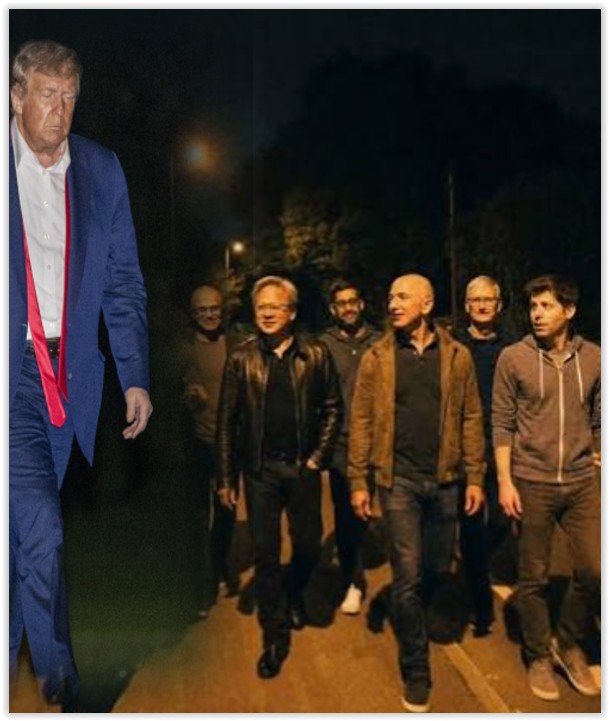
At these words Donald went into a fury, and was so terribly mortified that he knew not what to do with himself. At first, he resolved not to go to the great event, but he could not resist the desire to see if it really was Hogshead who’d found favour with the foreign prince, or yet another interloper. So he went, but as soon as he clapped eyes on Pete dressed as a knight of yore, he became so terrified with rage and astonishment, that he emptied his bowels fully into his brand-new suit. The faecal mass, without a diaper to stop its flow, came down his legs, and into his shoes, and onto the street, leaving a trail of human waste in his wake, whichever turn he took.
The whole incident was caught on the Octopus News cameras that Donald had ordered to follow him everywhere he went. Without an aid by his side, and no way to disguise his predicament, Donald went hurriedly from the scene, doing that stiff-legged walk thing, which only served to exaggerate his existing limp, and never showed his face in public again.


“Traitor, abuser, rapist, halfwit, bankrupt (morally), bankrupt (financially) paedophile, Russian asset, fraud, incompetent, money launderer, liar, educationally subnormal, adulterer, golf cheat, egotist, baby, incontinent, corrupt, thief, tax dodger, stinkbomb, Putin’s best ally, draft dodger, warmonger, Epstein’s best friend, racist, failure, perjurer, twat…”
You just left it a few light 🤣
LikeLike
Oh yeah, the talking mirror. Seems so obvious now. But the seven tech bros 🤣🤣🤣
LikeLike