
PUSSY’N’BOOTY – part I
a reworking of Charles Perrault’s Puss in Boots, by Hans Loë.
If you’d prefer to read this story in book form, this is the link to the kindle (.co.uk version ) [TBC] & (.com version) [TBC] ;
and this is the link to the paperback (.co.uk version) [TBC] & (.com version) [TBC].
Once upon a time, a wicked criminal, Charleston Kustard, languished in jail, where he was expected to die, for he had committed a great number of crimes and his sentence was long.
One day, the eldest of his four offspring came to visit him. And though the boy had been to see his father many times previously, this time young Jeb found himself wondering whether it might be one of the last, for prison did not agree with a man who had spent so much of his life living high on the hog.
Seeing the old man suffer so much for the privations of the place, Jeb said to him:
“Dear father, would you not ask the king for clemency? He will surely be kind to you. This spell in prison during which you have spoken no ill of him, might well have enhanced your credentials for an important office of state, or at least an ambassadorship overseas?”
“I cannot, my son,” said Charlie, a diminutive he’d picked up in the gaming rooms of New Jersey, and the all-you-can-eat resorts of Little St James. “I am here because I had a prostitute seduce your uncle, and had a private investigator photograph him with her so that he might not tell of my crimes. If I were to be released, he would surely kill me.”
“I suppose there is that,” said Jeb, “Uncle Bill is still very sore about all that stuff.”
“And,” added his father, “there were a hundred and thirty-two other offences taken into consideration. I fear that the gravity of my crimes is such that the good king could not contemplate a pardon lest it taints him too.”
Little Jeb, for that was how he was known, even though he was six foot eight, and almost as tall as the famous and fearsome giant, Peter Teapot, who controlled all the lands to the west, gave his father a puzzled look in want of a reply. He stood up, taking care not to rub his neatly combed hair against the ceiling of the cell, as his mother had instilled in him. “Do you want to give yourself a broken thatch, and end up looking like the king?” she’d scold him.
Then he began to pace his father’s cell, crab-wise to make the best of the space, in an attempt to press upon the old man that he was deep in thought.
“You could, though, eh?” he said eventually. “I mean, if you paid enough? He could secretly release you, and allow you to live some place quiet? Like that escort-courtesan-paedophile thing from Britain?”
His father held out an arm to bid him stop pacing. Drawing himself to the edge of his bed, his bowed head moving slowly from side to side, a bit like the way Jeffrey Epstein looked just after eating what he realised was to be his last meal, he emitted a low gurning noise of the type that had recently become fashionable with the king himself.
Then Jeb noticed tears dropping from his face onto the mattress between his legs.
“We cannot, son,” he said eventually, in a broken voice.
“Cannot what, father?” asked Jeb.
His father looked up at him, his eyes magnified by his tears. “We have nothing with which to pay the king. All our money has gone.”
“All of it?” cried Little Jeb. “But what of the mill, and that old folk’s home in which a thousand people live?”
“Gone,” said Charleston , shaking his head. “Or mortgaged, and soon to be foreclosed.”
“Gone where?” cried Jeb, suddenly terrified that all those stories of his father’s second, and maybe third, families were true after all.”
“First, I had to settle with my lawyers; then I had to pay-off all the people who’d given me false alibis; then there was the settlement with your ingrate of an uncle; and what was left, I used to pay-off the king so that the other charges might be dropped. We have nothing left with which to bribe him; he’s already had the best of what we had.”
In that very moment Jeb’s thoughts changed tack.
“The loathsome old toad will probably die soon anyway,” he thought to himself. “I’d better get myself home, and get my hands on all the portable property before the rest of them find out the news.”
Off he scurried, as quickly as his long spindly legs could carry him, back to the farm. Suddenly he saw it all through fresh eyes. The old place that he’d always looked upon as the very epicentre of his father’s empire.
What he’d always believed was a sort of affected shabby chic brought about by his mother’s artistic leanings, changed before his eyes into a dilapidated hotch-potch of buildings in want of repair. The old mill, no longer the very symbol of their attachment to what had once made America great, was now but the sole source of cheap power on which they relied.
The scales fell from his eyes. They were just the next family along in the ancestral line of peasant farmers. But what would make their new found plight unbearable to endure, was the fraudulent activities of their father, by which they’d dared to dream. To the last of them, each member of his family earnestly believed that they had been raised up in society. So seduced were they by the taste of what he now could see was but a temporary uplift in the flow of cash that washed through the smallholding.
His brother was out in the fields seeing to the wheat crop; his elder sister was in the kitchen with her account books; and his younger sister, already anxious to leave the homestead, practised the piano for want of anything better to do.
His mother was out on her rounds, giving to poor people the pennies her elder daughter found in her book-keeping, and some of that which ought to have been paid in tax by her husband.
Jeb rushed quickly around the barn, rejecting first the combine harvester, which he knew would be on finance, then the buggies and trailers, realising that they too would be similarly encumbered. He turned the key in the tractor, but before it coughed and spluttered into life, he jumped down from it.
“What am I thinking?” he said to himself. “Even that old workhorse, which is no use to anyone, will be the same.”
Eventually, he rounded up the livestock that served the farm, and took that with him down the road and away to make the best of his life.
He rode the donkey, and had the geese, hens, and dogs follow him, all hanging off the same long lead. Soon, the donkey tired.
“You never would work for me, would you?” he shouted at him, as he climbed down. And it was true, for the young master had never been kind to the donkey, and they had reached the stage in their relationship where it would only surrender its labour in direct proportion to his cruel urgings.
Now on foot, Jeb continued pulling and dragging at his halter until eventually the donkey downed tools altogether, and refused to go another step. With that, the dogs too slowed to a halt.
They all knew from hard won experience, that a life with Jeb would be all hard work and no reward with the occasional beating thrown in when things weren’t going the master’s way. They each dug in their heels until they were freed from the long leash. And soon after, the loose rabble of animals began, one by one, to drop off the back of the pack, and turn to head homewards. They each made their own particular noise and flurry as they did, until finally the last one left with a cry that sounded a little like, “So long, Lebbie. Good luck!”
Five miles into the journey, Jeb stopped for a rest, and it was then that he saw that nothing but the farmyard cat followed him now.
“You?” he said. “What can I start with an old tom cat, apart from a pair of fur gloves from your pelt? That way at least I can take some value from you, until I am rid of your welter weight, and so forge my journey alone.”
“It’s about time he found out that I can speak,” thought the cat. “The gombeen will have us dead before we get anywhere worth going.”
“Listen son,” he said. “Killing me to get a pair of bad gloves from my pelt, is a bit like burning dollar bills to keep warm.”
“Then what?” asked Jeb, in wonderment that the tom cat so spoke, unable to summon more words than just those.
The cat sighed. “It comes to a pretty pass when I have to choose between the hicks at home, who think that shooting things from ten yards in their own back yard is a good day out; and this dolt, who couldn’t write his own name without someone to guide his hand,” he thought.
As he reflected more about how he might persuade a boy so limited as Jeb Kustard to realise all that there was to be achieved at liberty with an animal such as he —one who saw everything, and knew yet more, a shoemaker walked by.
Taking inspiration from that coincidence, as if they were living in a fairy tale, he said to his master:
“Have him make me a leash and collar of high-quality leather.”
Such an odd request, thought Jeb. Still somewhat discombobulated by his speaking cat, he tried to form a sentence, “But for what…” he began.
“Shut up. I’m not finished,” said the cat. “Hanging from the collar, I want a smart cardholder, like those things you put on suitcases.”
“I do those,” said the shoemaker. “Anything in leather. I am a master craftsman. What is your name cat?” he said, licking the end of his pencil.
“Yeah, what is your name?” asked Jeb. “He can speak. Why wouldn’t he have a name?” he thought.
The cat smiled, this was going to be good.
“My adoptive father was a swan,” he said.
The shoemaker and Jeb turned to look at each other. Saying nothing, their expressions said, “What!?!”
“And I took my last name from him, Swanson. It’s how us animals do it —the way you used to.”
“Swanson, eh?” said the shoemaker. “Very handsome. I will make you a tag for your collar which says it too.”
“There is no need,” said the cat, “I am happy with my…”
“It’s no trouble,” said the shoemaker, talking over him. “The metal worker has the shop next door; he’ll happily do it for me. He makes all manner of things like that, keys too. For some reason he also provides a quick and cheap service to repair the heels of the boots and shoes I’ve made. So we’re always in and out of each other’s shops.”
“Cease!” Shouted the cat, but before he could begin again, Jeb piped up once more.
“So, why did the other animals shout good luck Lebbie, as they took their leave from us? It certainly wasn’t meant for me, I’m plain old Jeb Kustard, everyone knows that.”
The cat sighed, “My father migrated, his origins were at Lake Onegin, and there a swan is called a lebyed. He liked that I used his version of the name, especially when he was with us, so I got used to having two versions of the same name depending on the season. He was a hard task master, and he kept me to my lessons, especially those in his native language, and so all my friends knew to call me Lebyed, or Lebbie, when he was around.”
“I long to be able to speak in a foreign way,” said Jeb. “Are you sure it’s not swan-song. For that would not bode well.”
“Sir,” said the cat, becoming thoroughly impatient, “if you were to acquire for me those simple accessories, I assure you most wholeheartedly that in our time together, it will be the very opposite. I can forge your blossoming, if you were to but repay me with your trust now, and your loyalty hereafter.”
“How so?” asked Jeb.
The cat gestured silently towards the shoemaker with his eyes, and had Jeb go to the side with him so that they might not be overheard.
“Master. If you were to give me those cards, the ones I saw you take from your father’s desk just before we left the house, and let me carry them in my new cardholder which will hang from my collar, I will make it so.”
“I’ve since looked at those cards while we’ve been on this journey,” said Jeb. “They are not for bank accounts, and if they were, they’d be of little use now, for all my father’s funds have gone.”
“I know,” said Swanson. “They are pass and access cards from the time your father was in favour. If you would trust me with them, I can make them work well for both of us.”
“What are you going to do with them?” Jeb asked. “They didn’t do much good for my father.”
Swanson sighed as he rose up on to his back legs, and planting his front paws firmly onto his hips, said:
“Jeb Kustard. Compare and contrast, I Swanson, with your father. He is confined to jail where he will live until he dies in abject misery, because he was incapable of escaping the very web of lies that he himself created. And here am I, at liberty, stood at the side of this road now, talking to you, making plans for our future. Whose advice do you think you should follow?”
“Very well,” said Jeb, smiling again. “It shall be so. As soon as your new things are made, I will fill the holder with all the cards I possess.”
When they came back to the shoemaker to confirm the order, the man nodded his agreement, saying that he would see to the job soon. “But,” he added, “I’ll prioritise it to the very next thing I do, if you were to consider an upgrade to it.”
Swanson and his master exchanged a glance with each other. And in it, their thoughts met: the first person we meet on the road is trying to turn us over.
“Would Swanson not look well in a brand-new pair of cat boots too?” asked the shoemaker. “Very good, very cheap, for someone as small as a cat. Swan-cat I mean.”
“The swan was my adoptive father,” said Swanson.
“Yeah, I know,” said the shoemaker. “But you look one hundred percent cat to me, innit?”
“Dear me,” Swanson sub-vocalised, “you can’t cure stupid.”
He contemplated an explanation for a moment, then decided against it. “Do you not see my fine swan’s neck?” he asked. “Nor the sleek nap of my coat, the way every hair seems to run in the same direction; nor my beautifully symmetrical whiskers?”
“But you’re black,” said the shoemaker.
“And so was my father,” said Swanson. “You have yet to encounter a black swan?”
“That black swan who came to the farm each year? He broke my brother’s arm,” said Jeb.
The shoemaker edged forward a step, and took a closer look at Swanson, and he could see that the cat was possessed of a magnificently sleek and gleaming coat. “You really can see the graceful swan in him,” he thought.
And it was true in a sense. At the farm, Swanson, or more correctly when the season in which he was to be called Lebbie came around, he was sometimes said by his detractors to be “A triumph of grooming products over charisma.” Whatever the case, he was very much the product of his adoptive father, and by his mentoring, became a very striking, and capable cat.
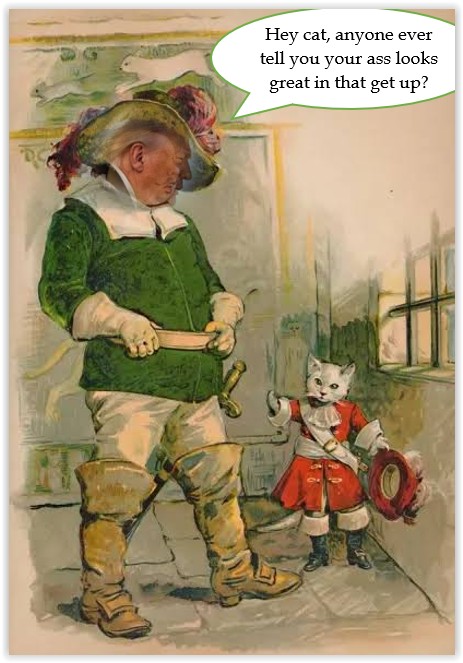
“Boots would really top off the image, given all that you’re trying to achieve,” said the shoemaker.
“And maybe a hat, too,” thought Swanson, but he decided to say nothing of it for the time being.
For Jeb Kustard’s part, he could no longer be surprised by anything that happened that day. In just a few hours, the ground had given way beneath his feet; everything he’d known was no more. He was no longer rich, as he’d always assumed. Destitute in fact. And the animals over whom he’d always held dominion, had refused to work for him any longer. And the cat, over whom he’d never held any sway —had seemed to dislike him in fact —here he was, not just the only one that remained, but speaking too! And with those words he spoke, calling the shots, as if he, not Jeb, was in charge of this new enterprise in which they found themselves.
His funds were limited, and he really needed to take care about the way in which he deployed them from now on, but, as his father had always advocated: “When your stack’s low, eking out the rest of your chips one at a time, is a guaranteed strategy to see them pissed away.”
Then another of the old man’s shibboleth’s came to his mind: “When your back’s to the wall, be bravest of all.”
“Make it so!” he said to the shoemaker. “Add a pair of boots to the order, and let this thing be done properly.”
Swanson was measured for a pair of fine boots, and a few days later, when they were ready, they went to the shoemakers shop to pick them up. The cat put them on straight away, then taking the sack in which they came and pulling it closed with the drawstring, he threw it over his back, and went on two legs, like a human, out of the door.
.
The king liked to eat very much, but he was particular about what came to his table. He professed to have a taste for beef, though in truth, it was just a particular derivative form of the meat.
He had no time for steaks and roast joints, saying that there was too much hard work in getting to the good bits. Besides, “Taken as a whole,” he would often say, “stuff like that was: just too meaty.”
So he had his chefs grind up the good bits of steaks into soft, digestible patties. Though the kitchen staff were inclined to call them hamburgers, the king would insist on their being referred to as beef, or chuck, because with those words came a cachet that other meats did not possess—and one that very much suited the image his majesty wished to project.
But there were two things about the beef he consumed that the king never quite grasped. The first was that the patties he so relished, were of no more than twenty-five percent meat; and the second, was that twenty-five percent was just today’s measure in what was now an established declining trend.
There being such rampant inflation in his kingdom, the costs of raising beef cattle, meant that their meat sold for a price most of his subjects could no longer afford; and the farmers, facing a falling market, had turned their attention elsewhere; and increasing numbers of them were turning away from farming altogether.
And as a consequence of all that, there came a scarcity of meat. Even wild meat, as all the easy prey came to be hunted from the region.
The cat knew all this because they had struggled through recent times on the farm themselves. And by necessity, he had already become an experienced hunter. What is more, he was one of the very few left of what had once been a large community of hunters and poachers in the region.
He came into the forest, and laid out his sack so that it was open, then he had his master hand over his lunch tin, and the bag of apples he’d seen him snaffle from the pantry. He diced the apples into small pieces, then broke up the sandwiches into crumbs and morsels of cheese. The Hershey Bar, he threw away into the trees for the rats and squirrels to eat, to keep them away from the trap he was laying. Then he ran out the sack’s cord into the grass, and took it behind a hedge. There he hid himself, snuck around, and lurked.
Soon, the hungry birds of the forest, hearing no gunshots, came running; partridges, pheasants, grouse, who one after the other hopped into the sack. When a good quantity was in it, Swanson pulled the cord closed, then he ran back and twisted the heads of the poor birds around, following which he threw the sack over his shoulder and went straight away to the king’s palace.
The watch cried: “Halt! What are you doing here? How did you get across the drawbridge without permission?”
“I’m a friend of the king,” answered Swanson quickly.
“You craze me,” said the watch, because he’d been recruited from Suffolk, England. “A cat he look at a king, I know that, but friends?”
“Just let him go,” said his colleague from the security guards’ box. He had taken his jacket off, and he’d put his cap on top of the small television he was watching, hoping that nobody would see it there.
But the cat, even though he walked on his hind legs, could see from his low angle, that the guard was watching Deal or No Deal, and they were down to the last five boxes. He didn’t have to say anything, for them to lose patience with their questions and let him through.
“The king is often bored,” said the man from inside the box. “And you know what cats are like, the way they play with balls of wool and that. It’ll probably amuse the halfwit.”
His colleague outside, who stood in front of Swanson, blocking his way, laughed at his friend’s remark. “The knob will probably think he bought it off the internet when he was fucking about on his phone in the middle of the night,” he said.
Hearing this, the guard inside the box changed his tone. “Come here would you a moment,” he said. Then gesturing conspiratorially with his eyes, bade his colleague to come into the box. “We have that report to produce, and it’s almost the hour.”
“Yeah, the Circus Maximus is ready to serve its main course,” thought Swanson, as the guard left his post and went into the box, leaving the cat free to wander on into the palace as he wished.
When he came in front of the king, he made a deep bow and said: “My master, the Marquis of Karaburun-Sazan lets himself be recommended to the king and sends him these gamebirds from his hunting grounds which he captured with great skill and sportsmanship.”
The king was much astonished over the magnificent plump birds, but he disappointed the cat when he responded, “I can see that they are really beautiful —the most beautiful birds anyone has ever seen. But I only eat real meat —cowboy meat. Chuck, I call it.”
Appearing quite crestfallen, Swanson bowed his head and said, “I have disappointed your majesty. I, not my master, for I advised him to send you the best of our land’s gamebirds.
“Do not misunderstand me, young cat. It delights me to see that my tariff policy is working so well. The shortage of meat that I have deliberately brought about, has finally started to encourage highly skilled local entrepreneurs like you and your master, to develop top-class, world-beating enterprises. And I like that you brought them to me first. That shows me that you’re thinking about this in the right way. What I want you to do now, is take them down to the chef, and he will use them well for everyone else. Then, when you leave here, you’re to tell everyone you see, that you’re living proof of the king’s great ideas in action. I’m the king by the way. Forgive me if I’m speaking too kingly for you, but it’s the best way to speak, so it’s what I do.” Then he made a strange noise, as if he were trying to cough up an engorged testicle through his internal passages.
Swanson smiled at him, nodded, and threw his sack back over his shoulder.
“Then,” said the king, as the cat was about to leave, “…come back here, and I’ll fill that sack with gold, and you can use that to expand your enterprise. Then, next time you visit me, you can bring me two sacks full of prime beef, because, thanks to my brilliance at economics, that is in short supply, but what there is left, where it can be found, is the very best. Now that we’ve sent all the useless cows back to Canadia and Greenland, we have ourselves the finest set of animals on the planet, and they will be the oranges of a magnificent enterprise. You and your master will no doubt find a way to breed from them, so that our bloodstock industry is the envy of the world. I can tell that you’re great at that sort of thing, just by looking at you. It’s what I do.”
“Yes sir, your majesty, indeed,” said Swanson, backing out of the room, “…livestock. Yes. A foundation stock bred in the absolute… purple.”
“You’ve got it, cat!” the king shouted after him. “You can almost speak king as well as me. They will be the oranges that make American farming great again.”
In the palace kitchens, Swanson presented the gamebirds to the chef, whose eyes popped out on stalks.
“Thank God!” he cried. “Bring them here.”
And as Swanson set out the fayre on the chef’s preparation counter, where nothing else stood, the chef said, “That’s the first fresh meat we’ve seen in here in weeks. Months maybe. Where did you get them?”
The cat told the chef that his master had captured the birds in his own hunting grounds, and the chef, so excited to hear that news, immediately pressed him to supply more, and regularly.
“But…” began Swanson, indicating with his paw, the direction in which he had just come.
The chef talked over him, “Ignore that fat fool,” he said, “He’s been eating burgers made of old shoes for the last two months, and didn’t notice the difference.”
Swanson then told him of the king’s wish to have fresh beef delivered.
“Good luck with that project,” he said. “But if you succeed, it will be worth twice its weight in gold. More, for that old know-nothing scrote has a cellar-full of ill-gotten gold, but cannot buy a piece of fresh produce to save his life.”
Swanson nodded sagely at hearing this nugget of information.
“But hurry,” he said. “You’ve seen the state of him. If he doesn’t start eating proper food soon, bits will start dropping off him.”
“He seems to have a thing about oranges,” Swanson said.
The chef laughed, “For oranges we’re fine. We dare not feed him one in case, you know…” and he made a circular gesture with his finger towards his face.

The cat made to leave, assuring him that he would return soon, with all the fresh meat he could acquire, and would bring what couldn’t be seen by his majesty, straight to the kitchens.
“Don’t even bother with that,” said the chef. “He’s got the attention span of a mayfly. Just bring it straight here, and I will tell him whatever makes the story good. In fact,” he added, in the way of all good catering managers, “I’ll pass off the game as beef for a cut in the deal.”
That was the way Swanson’s father, Sasha had trained him, and he sealed the deal with his new friend with a wink. Then he scurried off to see the king, who did indeed fill his sack with gold coins.
As he left the palace, and went once more to cross the drawbridge, he flicked a coin into the security guards’ box which landed at the feet of the two men transfixed by the blue-grey glare coming from under one of their caps. They looked up fleetingly to see Swanson with his heavy load swung over his shoulder, and put their thumbs up at him.
Poor Jeb Kustard though, had no idea what had passed at the palace. He doubted that the farmyard cat had even been able to enter the place, and he prepared himself for the stories he’d be told on his return.
He sat behind a roadside hedge, on the field side of it, his head slumped in his hands as he waited. And as he did, he weighed many negative thoughts. He seemed to have spent many moments of his life like this, waiting for someone to come back with a result, a reaction, a “this is what they said,” and “this is what we do next,” and each time he did, he vowed to himself never to do it again.
Always the same, someone better at organising their thoughts and words had him outmanoeuvred from the get-go; his fortunes always in the hands of someone who was slicker than him with speech. His father mainly; his brother and cousins sometimes, because of their sheer cruelty, brute force, and desire to succeed; his sisters often; boys at school; and now the cat! He had spent his last on the cat’s boots! Boots for a cat of all things! Because the cat was a better negotiator than him. Him, Jeb Kustard, a real live human, all growed-up to the proper size. It had been because his father had brow-beaten him so often, he decided.
“He turned me into a people-pleaser that wretch of a parent! Destroyed me before I started. What chance did I ever have? I may be a dolt, but I wasn’t a nurtured and cosseted dolt, like other boys at my school. I was treated as an inadequate young adult from as soon as I could talk for myself. And now look! I wait in dread for a cat to tell me my fate, and whether I might eat tonight.”
Thereupon Swanson appeared through a gap in the hedge, threw down his sack, untied it, and shook the gold out in front of Jeb, saluting him by removing his new hat, and making a bow.
“There you have something for the boots,” said Swanson, so pristine and manicured you’d swear he was made from Lego.
Jeb swooned with delight.
“Oh, and the king also greets you, and says many thanks to you,” he added.
Jeb was glad over the new wealth, without quite understanding how it came to be.
“Thanks for what?” he asked.
The cat sat down, had Jeb help him off with his boots, then proceeded to tell him everything.
“We’ve got to get back to that king, and use this to pay for my father’s release,” said Jeb.
Swanson sighed, shaking his head. He remained sitting.
“The king has more gold than he knows what to do with,” he said. “He hardly values it —that’s why he swapped it for a bag of meat. Why would he want his own coins back?”
“But looka here,” said Jeb, pointing at a torn scrap from a newspaper that had blown in his direction. “Pardons are down to fifty sovereigns a head. It’s there, look! On the Pennsylvanian stock exchange, just under pork bellies.”
Swanson took to his feet.
“Did you ever hear the story,” he said, as he gained his balance. “The one where, way back in the olden days, itinerant workers would head to London because they heard it said that the streets were paved with gold?”
Jeb Kustard shook his head to say, “No.”
“Well,” Swanson went on, “two men arrived from a faraway place one day, and one of them, seeing a bright shining sovereign laying on the ground before them, bent to pick it up.”
Swanson’s eager audience nodded his head now, engaged with the riveting tale.
“Before he did, he felt his friend’s arm reach out to stop him. ‘Leave it,’ said the friend, ‘we’ll start work tomorrow.’” He smiled towards Jeb, and when Jeb remained silent, Swanson added, “We should not be like him.”
To which Jeb replied, “Which one?”
The cat went back onto four legs, then hopped up on to a short wall nearby.
“We must make hay, master. Compared to yesterday, you are rich, yes. But compared to what you might well become? Those gold sovereigns lying at your feet, they will soon look like the life savings of a pauper. Tomorrow, with my boots on again, and my new relationship with the king and his palace, you will be richer still.”
Jeb looked at the cat with his mouth wide open, unable to find a single word by way of response.
“Oh, and you’d better get your shit together. He thinks you’re a Marquis.”
Swanson gave Jeb a crash course in what it meant to be a Marquis, and how they behave, then, each day, he’d put on his boots, and leave him to his studies, while he went out hunting. Some days he’d directly visit the king, but most, as arranged, he’d drop his catch off with the chef, who would then broker the arrangement to the king.
It worked better that way because soon there were no more gamebirds and fowls for the taking. He’d leave them a few days to restock, then try again, but there were no two ways about it, their numbers were on the wane. So, in those short days, as he came to call them, the cat would look about him for other meats to take to the palace.
For a while he flirted with foodbanks. New ones were popping up all over the place, but none of the rare and expensive meat found its way into such places; besides, a cat in handmade boots —it was just too conspicuous. Though his research served a purpose, because whilst checking out the largest foodbank in the area, he managed to hop on to a lorry which had just dropped off a load, and went back with it to where it came. And there he saw something.
The unsold food which didn’t make it to the foodbank, he saw was being dumped in large bins behind the store. He took a peek inside, and found all manner of things.
“What is a dead partridge, but a ripe piece of raw meat waiting to be consumed?” he told himself as he tossed a string of sausages past their sell-by date, into his sack.
The first time he went with this new produce to his friend the chef, he was not angry as Swanson had expected him to be, but rather the reverse. He liked the variety of food that was set before him, telling the cat, “As long as we never run out of ketchup, we’ll be fine,” and he gave him one of his winks again.
In this way, it wasn’t long before the king was eating pre-soaked, uncooked lasagne sheets, believing them to be the cowboy burgers he so loved. And with it, the cat and his master grew richer, and with them too, the cat’s many friends at the palace, who all helped to make his secret enterprise coordinate like a finely tuned watch.
One day, Swanson stood in the king’s kitchen by the stove, warming himself, when the coach man came in cursing loudly.
“I wish the king and the princess were facing a televised firing squad! I was going to go down the boozer. I’ve got a five-timer running on to that good thing of Prescott’s in the Cesarewitch, and I was going to watch it with the boys. Now I have to take the ponce out for a day at the lake. And have you seen the girl lately? If she dared smile, her face would crack.”
On hearing this, Swanson snuck home and told his master:
“If a Marquis you are to be and become rich, so come with me outside to the lake and bathe yourself. To be honest, you’re a little overdue.”
Jeb did not know what he should say to that, but followed Swanson nevertheless, because everything he’d advised him thus far had come true, and delivered substantial wealth already. He went with him, and on the instructions of Swanson, discarded everything he was wearing, and went into the lake, even though he’d already had his summer bath.
As soon as he did, Swanson took the pile of clothes, and carried them away to hide them behind a rock. No sooner was he finished doing that, than the king came driving by.
Part II to follow shortly…


Rutling Orange Peel? 😂 It’s a long time since I’ve heard of him!
LikeLike
bring on part II. Best yet IMO. Who is going to be the magician? It can only be one person, surely….
I’ll be disappointed now if it isn’t him.
LikeLike